FHSS vs DECT Baby Monitor: What’s the Difference and Which One Is Better?
When choosing a baby monitor, parents often come across two technical terms: FHSS and DECT. While both are wireless technologies designed to transmit audio and video securely, they work in different ways and have different strengths.
In this guide, we’ll explain in simple terms what FHSS vs DECT baby monitors are, how they work, what the differences are, and which one is the better choice for your baby and home.
WHAT IS FHSS?
FHSS stands for Frequency Hopping Spread Spectrum.
An FHSS baby monitor works by rapidly switching (or “hopping”) between many different frequency channels during transmission. This makes the signal:
- Harder to intercept
- More resistant to interference
- More secure than traditional fixed-frequency monitors
🔹 Benefits of FHSS baby monitors:
- Very good privacy and security
- Less interference from Wi-Fi, Bluetooth, and other devices
- Stable connection in apartments and crowded areas
- Widely used in non-WiFi baby monitors
🔹 Downsides of FHSS:
- Slightly more complex technology
- Quality depends on the implementation and hardware quality
WHAT IS DECT?
DECT stands for Digital Enhanced Cordless Telecommunications.
DECT technology was originally developed for cordless phones and later adapted for baby monitors. It uses a dedicated frequency band and digital encryption to transmit audio (and sometimes video).
🔹 Benefits of DECT baby monitors:
- Very stable and reliable connection
- Excellent audio quality
- Good protection against eavesdropping
- Low interference from other household devices
🔹 Downsides of DECT:
- Mostly used for audio-only baby monitors
- Fewer video models use DECT
- Less flexible compared to FHSS for video transmission
FHSS VS DECT: SIDE-BY-SIDE COMPARISON
| Feature | FHSS | DECT |
|---|---|---|
| Security | Very high | Very high |
| Interference resistance | Excellent | Excellent |
| Audio quality | Very good | Excellent |
| Video support | Yes | Rare |
| Range | Very good | Very good |
| WiFi required | No | No |
| Best for | Video + audio monitors | Audio-only monitors |
WHICH ONE IS MORE SECURE?
Both FHSS and DECT are considered very secure compared to Wi-Fi baby monitors.
- FHSS protects your signal by constantly changing frequencies.
- DECT protects your signal using dedicated frequencies and digital encryption.
For practical purposes, both are safe choices and extremely difficult to hack or intercept.
WHICH ONE SHOULD YOU CHOOSE?
✅ Choose an FHSS baby monitor if:
- You want a video baby monitor
- You want a non-WiFi system
- You want maximum flexibility and modern features
✅ Choose a DECT baby monitor if:
- You only need audio monitoring
- You want excellent sound quality
- You want a simple, ultra-reliable solution
REAL-WORLD RECOMMENDATION
Today, most modern non-WiFi video baby monitors use FHSS, while DECT is mainly used in audio-only models.
If you want to see and hear your baby, FHSS is usually the better and more future-proof choice.
If you only need to hear your baby, a DECT monitor can be a simple and reliable option.
FINAL VERDICT
Both FHSS and DECT are safe, secure, and reliable technologies.
🔹 FHSS is best for video baby monitors and modern setups.
🔹 DECT is best for audio-only baby monitors and simplicity.
For most parents today, FHSS baby monitors offer the best balance of features, security, and flexibility.
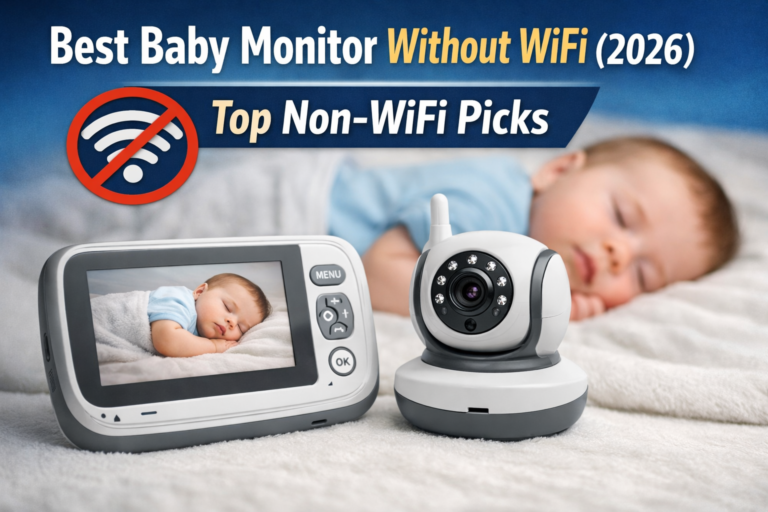
If you’re looking for the best non-WiFi options, check out our guide to the Best Baby Monitor Without WiFi.