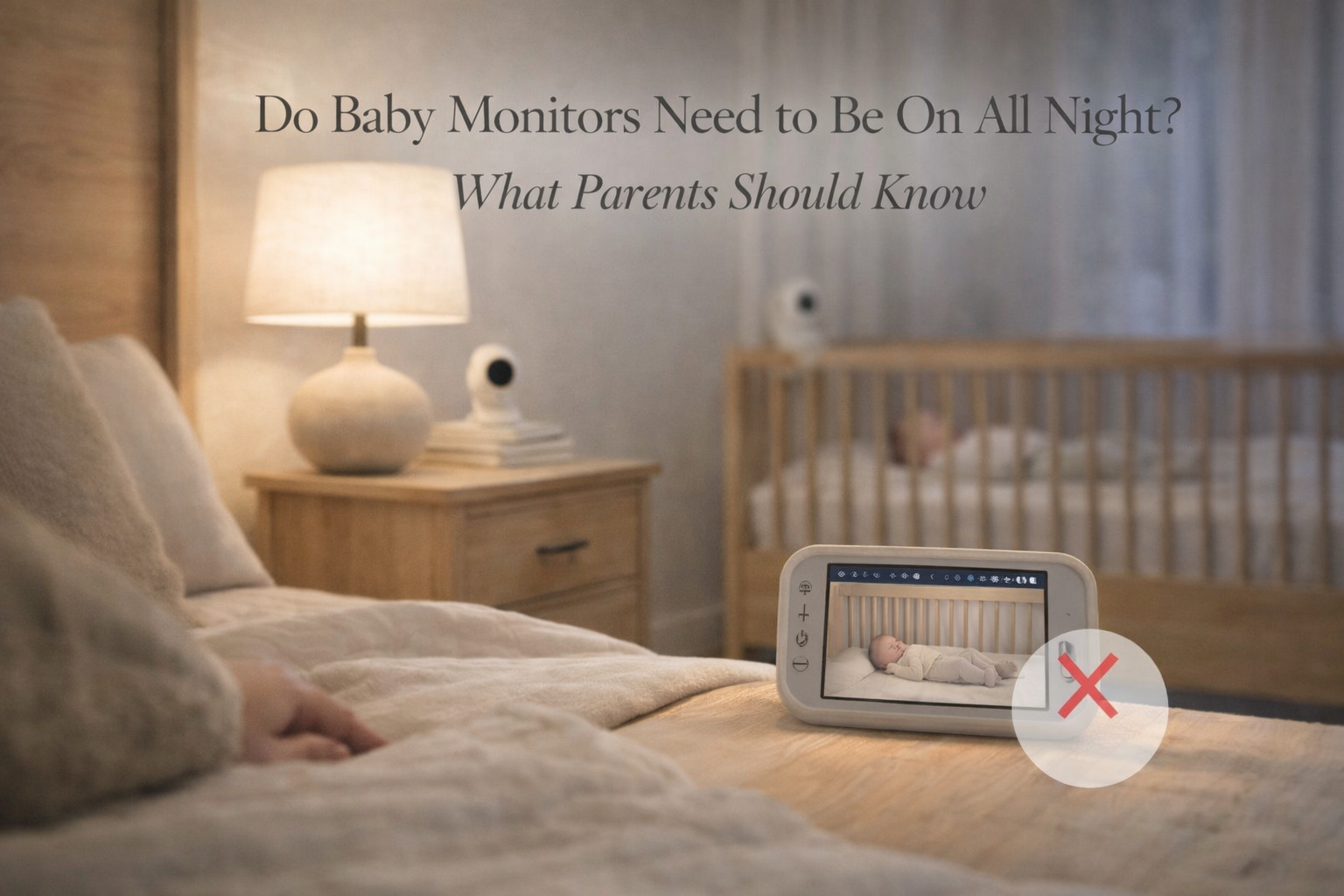
Do Baby Monitors Need to Be On All Night? What Parents Should Know
Do baby monitors need to be on all night? It’s a question many parents ask quietly, often after weeks of broken sleep and constant checking. At first, the monitor feels like a lifeline. You can hear every sound. You can see the crib without getting out of bed. You feel more in control.
But eventually, some parents start wondering whether leaving the monitor on all night is truly necessary or whether it’s creating more stress than comfort.
Maybe the screen keeps waking you up with movement alerts. Maybe the baby makes constant grunting noises that sound loud through the speaker. Maybe you’re worried about WiFi exposure, battery drain, or privacy. Or maybe you simply want to know if you can relax a little without feeling like you’re taking a risk.
The honest answer is that many parents do keep baby monitors on all night, especially in the newborn stage, but not every family needs to. The decision depends on where your baby sleeps, how your home is laid out, and what kind of monitor you use.
This article explains when it makes sense to keep a baby monitor on overnight, when it may not be necessary, and how to use monitoring technology in a way that supports better sleep for both parents and baby.
Why Parents Leave Baby Monitors On All Night
For many families, the baby monitor becomes part of nighttime survival.
During the first months, babies wake frequently. Feeding schedules are unpredictable. Some babies are noisy sleepers. Parents are exhausted and want to avoid unnecessary trips to the nursery.
A baby monitor can help because it allows parents to:
- respond quickly when the baby truly wakes
- distinguish between active sleep and real crying
- avoid walking into the nursery too early
- feel reassured without constantly checking
For parents sleeping in a different room or on a different floor, overnight monitoring is often essential. Without it, they may not hear the baby at all.
In those situations, leaving the monitor on all night is not only normal it’s practical.
Do Baby Monitors Need to Be On All Night for Newborns?
For newborns, many parents find overnight monitoring helpful, but it depends on where the baby sleeps.
If your newborn sleeps in the same room as you, you may not need a monitor overnight. You can hear and respond naturally. In that case, the monitor may be more useful during naps or when you step away briefly.
If your newborn sleeps in a separate nursery, then keeping the monitor on overnight is usually the safest and most comfortable option. It gives parents awareness without needing to physically check the crib repeatedly.
That said, it’s important to remember that baby monitors are not medical devices. They are tools for convenience and reassurance, not a guarantee of safety. Safe sleep practices matter more than constant monitoring.
If you want a broader view of how monitoring fits into nighttime care routines, your pillar page Baby Sleep & Night Care: A Practical Guide for New Parents is a natural internal link here because it explains the real-life balance between baby safety, parental rest, and nighttime routines.
When You Might Not Need a Baby Monitor On All Night
There are situations where leaving a monitor on overnight is not necessary.
Baby sleeps in the same room
If your baby is in a bassinet beside your bed, you will naturally hear them. Many parents keep the monitor off at night and only use it during daytime naps.
Small apartment layout
In small apartments, parents can often hear the baby from any room. A monitor may still be helpful, but it may not be essential overnight.
Parents are light sleepers
Some parents wake easily to any sound. For them, a monitor can actually create more disruption than benefit.
Older baby with established sleep routine
Once a baby is older and sleeping more consistently, some parents stop using the monitor overnight or reduce usage to audio-only.
For many families, monitor use evolves over time. What feels essential at 2 weeks may feel unnecessary at 8 months.
The Hidden Problem: Baby Monitors Can Disrupt Parents’ Sleep
One of the biggest reasons parents question overnight use is that baby monitors can be loud and stressful.
Newborns are noisy sleepers. They grunt, wiggle, and breathe loudly. Through a monitor speaker, those sounds can feel amplified and constant.
Parents often keep the volume high because they’re afraid of missing crying. But the result is that they wake repeatedly for normal sleep sounds.
Over time, this can lead to exhaustion and anxiety.
Many parents feel guilty turning the volume down. But there is a difference between being alert and being sleep-deprived.
A monitor should support rest, not prevent it.
If you’re struggling with the emotional side of nighttime monitoring, your pillar article Baby Sleep & Night Care: A Practical Guide for New Parents is highly relevant because it helps parents understand what noises are normal and how to avoid the constant “alert mode” cycle.
VOX Mode vs Continuous Monitoring Overnight
Many monitors offer a feature called VOX mode, or sound activation.
In VOX mode:
- the screen stays off
- audio stays quiet
- the monitor activates only when sound reaches a certain threshold
This can improve parent sleep significantly because it reduces constant background noise.
However, VOX mode must be configured correctly. If sensitivity is too low, parents may worry the monitor could miss early crying or quiet fussing.
This is why some parents prefer continuous monitoring overnight, even if it’s noisier.
If you’re concerned about missing crying, your cluster post Can Baby Monitors Miss Crying? What Happens in Real Use connects perfectly here. It explains how sensitivity and VOX mode behave in real homes and what settings reduce the risk of missed alerts.
For many parents, the best compromise is VOX mode with high sensitivity. That way, the monitor stays quiet most of the time but activates quickly when the baby truly needs attention.
Does Keeping a Baby Monitor On All Night Cause Overheating?
In most cases, no. Baby monitors are designed for continuous use.
However, any electronic device can overheat if:
- placed in direct sunlight
- placed near heaters
- covered by fabric
- enclosed in a tight shelf with no airflow
If your monitor camera feels warm, that’s usually normal. But if it feels hot or shuts down unexpectedly, placement should be adjusted.
Wall mounting often improves airflow and reduces the chance of overheating.
What About Battery Life If the Monitor Stays On All Night?
Battery life is a practical concern, especially with parent units.
Most parent units will not last an entire night on battery if the screen is constantly on at high brightness. That’s why many parents leave the parent unit plugged in overnight.
Some parents worry that leaving the unit plugged in constantly will ruin the battery. In practice, most modern devices are designed to handle charging safely, but battery performance may degrade over years of heavy use.
If you rely on the monitor nightly, it’s reasonable to keep it plugged in and treat it like a bedside device.
WiFi monitors are different. Your phone battery may drain faster if the app runs continuously, especially if the screen stays open. Many parents keep the phone plugged in overnight or use a dedicated tablet.
Do Baby Monitors Need to Be On All Night for Safety?
This is where many parents feel conflicted.
A baby monitor can help parents respond faster, but it does not prevent SIDS and does not replace safe sleep guidelines.
Safe sleep includes:
- baby sleeping on their back
- firm mattress
- no pillows or loose blankets
- safe sleep clothing
- smoke-free environment
- appropriate room temperature
If those conditions are met, a monitor is mainly a reassurance tool.
For many parents, the real safety benefit is that the monitor helps them avoid oversleeping and missing cues when the baby is in another room.
So while a monitor is not required for safety, it can provide practical support.
Is It Better to Use Audio-Only Overnight?
Some parents switch to audio-only overnight because video can be overstimulating.
Video encourages parents to check the screen repeatedly, even when the baby is sleeping normally. This can create a habit of constant monitoring, which increases anxiety.
Audio-only monitoring can reduce that habit. It allows parents to respond when needed without staring at the screen.
Some parents keep video available but keep the screen off unless they hear a concerning sound.
This is often a healthy balance.
If you’re comparing monitor types, your pillar page Baby Monitors: The Complete Guide for Parents fits perfectly here because it explains which monitor type works best for different families and lifestyles.
What If the Monitor Loses Signal Overnight?
Another reason parents hesitate to rely on monitors overnight is signal reliability.
If a monitor disconnects at night, parents may not notice immediately. This is especially true with WiFi monitors, where notifications can fail if the phone is on silent mode.
If your monitor has signal drops, overnight use can feel stressful.
In that case, improving stability matters. Your earlier post How Often Do Baby Monitors Lose Signal (And Why) supports this topic directly and gives parents practical troubleshooting steps.
Some parents choose non-WiFi monitors specifically because they are more predictable overnight and don’t rely on routers.
That’s why your money page Best Baby Monitor Without WiFi fits naturally in this conversation. Many parents searching this topic are looking for a stable overnight solution without WiFi complications.
How to Use a Baby Monitor Overnight Without Losing Your Mind
For many parents, the best question isn’t whether to use a monitor all night. It’s how to use it in a way that supports sleep.
A healthy overnight setup often includes:
- VOX mode enabled (if reliable)
- sensitivity set high enough for newborn crying
- volume at a moderate level (not max)
- screen brightness lowered
- parent unit placed near your bed but not directly next to your pillow
- video checked only when needed
- monitor securely placed and cords managed safely
Parents often think “more monitoring equals more safety,” but in reality, over-monitoring can increase anxiety and reduce sleep quality.
A calm parent is a safer parent.
Final Thoughts
So, do baby monitors need to be on all night? For many families especially when the baby sleeps in a separate room keeping the monitor on overnight is both practical and comforting.
But not every parent needs constant monitoring, and some families sleep better by using VOX mode, lowering volume, or switching to audio-only overnight.
The goal isn’t to watch every second. The goal is to stay connected enough to respond when your baby truly needs you, while also protecting your own rest. When used thoughtfully, a baby monitor can support both baby safety and parent well-being.
FAQ
Do baby monitors need to be on all night for newborns?
Many parents keep baby monitors on overnight when the newborn sleeps in a separate room. If the baby sleeps in the same room as the parents, overnight monitoring may not be necessary.
Is it safe to leave a baby monitor on overnight?
Yes, baby monitors are designed for long-term use. The main safety concerns are cord placement and ensuring the camera is mounted securely and not too close to the crib.
Can leaving a baby monitor on all night disrupt parent sleep?
Yes. Newborns make frequent normal noises, and monitors can amplify them. Using VOX mode or lowering volume can reduce unnecessary wake-ups.
Should I use VOX mode overnight?
VOX mode can improve parent sleep by activating only when sound is detected. Parents should test sensitivity settings to ensure the monitor triggers reliably for crying.
Is audio-only monitoring enough at night?
For many families, audio-only monitoring is enough. Some parents prefer audio overnight to reduce anxiety and check video only when needed.