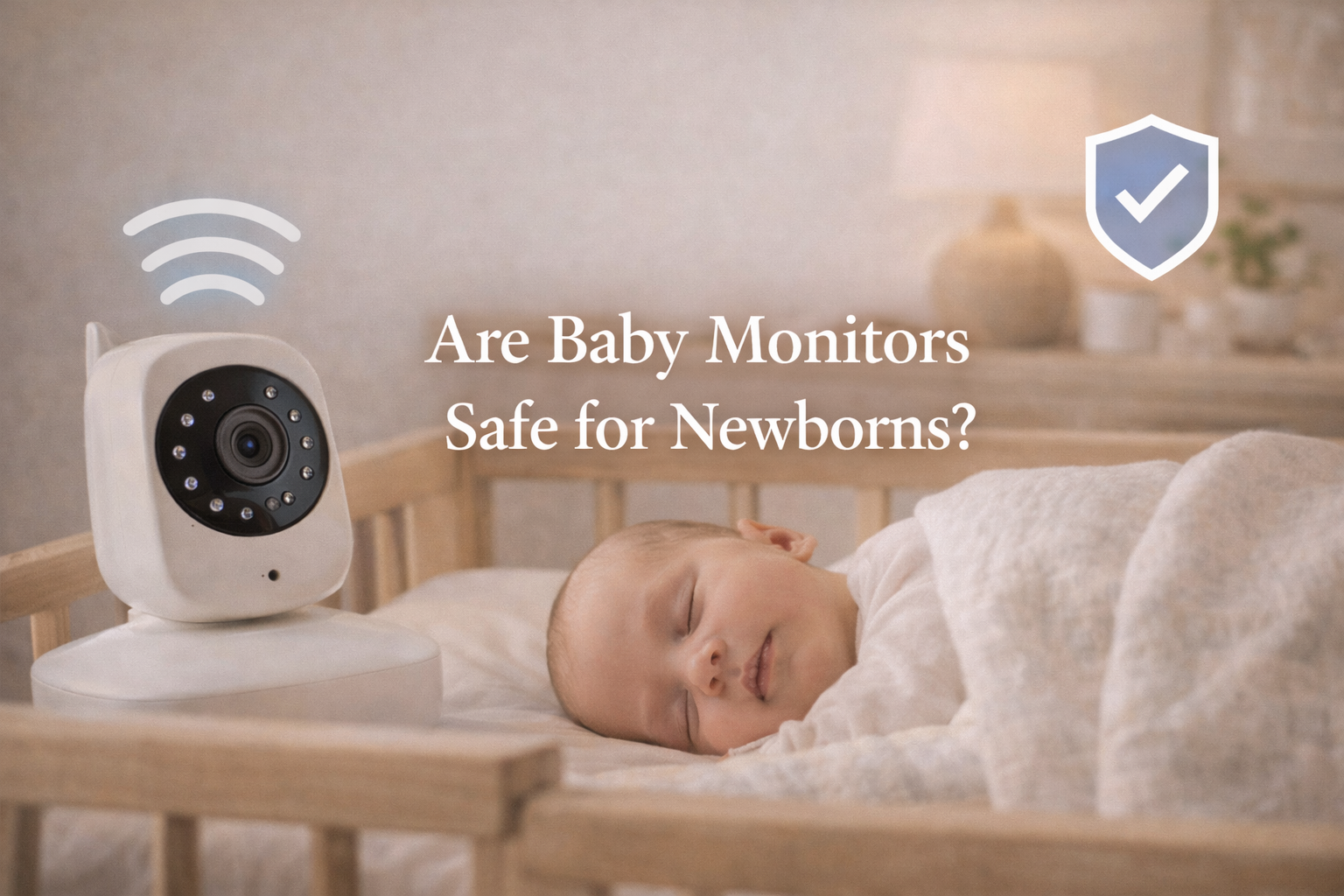
Are Baby Monitors Safe for Newborns? What Parents Should Know
Are baby monitors safe for newborns? For many parents, this question comes up within the first few days of bringing a baby home. You might set up a monitor in the nursery, feel relief that you can finally hear every sound, and then immediately wonder: Is this device actually safe? Is it emitting radiation? Could it disturb sleep? Could someone hack it? Could it create unnecessary anxiety?
These are not paranoid questions. They’re the kinds of concerns that show up when you’re responsible for a tiny human who sleeps unpredictably, breathes quietly, and seems fragile in a way no parenting book can fully prepare you for.
The truth is that baby monitors are widely used and generally considered safe when used properly. But “safe” depends on the type of monitor, where you place it, how you secure it, and how you use it as part of your overall newborn care routine.
This article covers the real safety issues parents should understand including EMF exposure concerns, strangulation risks from cords, sleep disruption, privacy risks, and best practices for safe use.
Are Baby Monitors Safe for Newborns in Terms of Radiation and EMF?
When parents worry about “radiation,” they are usually referring to radiofrequency (RF) signals, sometimes called EMF (electromagnetic fields). Baby monitors use wireless signals to transmit audio and video, similar to WiFi routers, Bluetooth devices, cordless phones, and even baby sound machines.
Most baby monitors emit low levels of RF energy, and for the majority of families, this exposure is considered minimal and comparable to other everyday household electronics.
That said, it’s understandable that parents want to minimize unnecessary exposure for newborns, especially during long sleep periods when the monitor may be running for hours.
The key thing to understand is that RF exposure drops dramatically with distance. A baby monitor placed several feet away from the crib produces far less exposure than a monitor placed right next to the baby’s head.
In other words, you don’t need to panic about the monitor existing in the room. You simply need to place it intelligently.
Safe Distance: How Far Should a Baby Monitor Be From a Newborn?
One of the simplest safety steps is also one of the most effective: keep the baby monitor at a safe distance from the crib.
A good rule is to place the camera or audio unit at least 3 feet (about 1 meter) away from your baby’s sleeping position. Many parents mount the camera on a wall or shelf, angled down toward the crib. This gives a better view and reduces direct exposure.
Placing a monitor directly on the crib rail or inside the crib area is not recommended. It increases both RF exposure and physical hazards, such as cords, falling devices, or overheating near bedding.
Distance also helps reduce the chance of your baby being disturbed by small indicator lights, clicking noises, or night vision switching.
The Biggest Real Safety Risk: Cords and Strangulation Hazards
When talking about baby monitor safety, cords are often the most overlooked issue — and arguably the most serious.
Many baby monitor cameras use power cords that hang down from wall outlets or furniture. If those cords are within reach of a crib, they can become a strangulation risk as your baby grows and becomes more mobile.
Even if your newborn cannot reach the cord today, babies develop quickly. A setup that feels safe at two weeks old may become unsafe within months.
To reduce this risk:
- keep all cords well out of reach
- avoid letting cords dangle near the crib
- use cord covers or cable management clips
- mount the camera high enough that the cable can’t be grabbed later
This is one of the strongest arguments for planning your monitor setup early rather than “fixing it later.”
Can Baby Monitors Disrupt Newborn Sleep?
A newborn’s sleep is fragile and inconsistent, and many parents worry that baby monitors might make sleep worse. In most cases, the monitor itself does not disrupt sleep but certain features can.
Here are the most common ways monitors can interfere:
Bright lights in the nursery
Some baby monitor units have power LEDs that are surprisingly bright. If the camera is placed at eye level or facing the crib, that light may become a distraction.
Loud static or feedback
Some audio monitors can produce background noise or feedback if volume is too high. Newborns can be sensitive to sudden sound changes.
Night vision clicking sounds
Many video monitors use infrared night vision. Some models make a quiet click when switching between day and night mode. This is usually harmless, but in very quiet rooms it can be noticeable.
Parents overreacting to normal newborn noise
This is a major one. Newborns grunt, squeak, breathe loudly, and make random sounds that can seem alarming through a monitor speaker. Some parents keep the volume too high and end up waking themselves repeatedly, increasing stress and exhaustion.
In this sense, the monitor can indirectly disrupt the household’s sleep not because it’s unsafe, but because it creates constant alertness.
For deeper guidance on balancing monitoring with realistic newborn sleep expectations, the article Baby Sleep & Night Care: A Practical Guide for New Parents fits naturally into this conversation and can help parents build a calmer night routine.
Are WiFi Baby Monitors Safe for Newborns?
WiFi baby monitors are extremely popular because they allow parents to check the baby from a phone, even outside the home. But when parents ask “Are baby monitors safe for newborns?” WiFi models usually raise the most questions.
The main concern is not physical safety. It’s privacy and cybersecurity.
WiFi baby monitors connect to the internet. That means they rely on:
- your home router security
- the manufacturer’s app security
- password strength
- software updates
- cloud storage systems (in some cases)
If a WiFi baby monitor is poorly secured or uses weak passwords, it could theoretically be accessed by unauthorized users. While these cases are not the norm, they have happened enough that parents should take the issue seriously.
The monitor isn’t dangerous just because it uses WiFi, but it requires responsible setup.
How to Make a WiFi Baby Monitor Safer
If you use a WiFi baby monitor, there are practical steps that dramatically reduce risk.
Use a strong unique password
Avoid simple passwords like “baby123” or reused passwords from other accounts. Use a strong password with length and complexity.
Enable two-factor authentication if available
Some baby monitor apps allow extra security verification. If it exists, turn it on.
Keep firmware updated
Many monitor vulnerabilities come from outdated firmware. Regular updates close security gaps.
Use a secure WiFi network
Make sure your home WiFi is protected with WPA2 or WPA3 encryption. Avoid outdated router settings.
Avoid sharing logins
If multiple family members need access, give them proper access through the app rather than sharing a password casually.
Review recording and cloud settings
Some WiFi monitors store footage in the cloud. Parents should understand exactly what is stored, for how long, and whether it can be deleted.
If you want a deeper breakdown of how monitors work, features, risks, and what matters most for parents, Baby Monitors: The Complete Guide for Parents is a strong internal resource to link here, since it provides a full overview of monitor types and what to prioritize.
Non-WiFi Monitors: A Simpler Option for Parents Who Want Privacy
Many parents choose non-WiFi monitors because they want peace of mind. These monitors use a dedicated parent unit and do not connect to the internet.
The advantages include:
- no hacking risk through the internet
- no cloud storage concerns
- no app accounts or logins
- fewer network interruptions
- simpler operation during stressful newborn nights
The trade-off is that you can’t check your baby from outside the home. But for many families, especially in the newborn stage, that isn’t necessary.
Parents who prioritize simplicity often find that a non-WiFi monitor reduces anxiety rather than increasing it.
If you’re researching this option, your money page Best Baby Monitor Without WiFi is a perfect fit to include naturally, because it targets parents specifically looking for safe, reliable monitoring without internet-based privacy risks.
Do Baby Monitors Overheat or Pose Fire Risks?
It’s rare, but any plugged-in electronic device can overheat if it’s poorly ventilated or covered.
Baby monitors are generally safe when used correctly, but avoid these mistakes:
- don’t cover the camera or parent unit with blankets
- don’t place it on soft bedding or inside a crib
- don’t block vents
- avoid cheap third-party chargers that aren’t compatible
- ensure cords and adapters are undamaged
Most baby monitors are designed for continuous use, but like any electronic device, they should be kept in a safe position where airflow is normal.
Wall-mounting or shelf placement is typically safest.
Can Baby Monitors Cause Anxiety for New Parents?
This is one of the most overlooked safety topics, because it’s not about the baby’s physical health — it’s about the parents’ mental health.
Baby monitors are supposed to reduce worry. But in some households, they create a cycle of constant checking.
Newborns make unpredictable noises. They twitch, startle, and breathe irregularly. If you’re watching a monitor constantly, it can be hard to relax. Some parents find themselves checking the screen every few minutes, even when the baby is sleeping peacefully.
This doesn’t mean monitors are harmful. It means they should be used as a support tool, not a source of hypervigilance.
If you notice the monitor making you more anxious, it can help to:
- lower the volume slightly
- use sound activation mode
- avoid staring at the video feed constantly
- rely on safe sleep practices first, not technology
A monitor should help you sleep better, not make you feel like you’re on duty 24/7.
What About Smart Wearable Baby Monitors?
Some parents use wearable devices like sock monitors that track oxygen levels or heart rate. These are different from standard baby monitors.
While wearables can provide reassurance for some families, they can also lead to false alarms, increased anxiety, and over-dependence on numbers rather than real baby behavior.
Pediatric experts generally emphasize that safe sleep practices are more important than consumer monitoring devices. Wearables can be helpful in specific medical situations, but for healthy newborns they are usually optional.
If you choose to use wearable monitoring, it should not replace:
- back sleeping
- a firm crib mattress
- no loose blankets or pillows
- safe swaddling practices
- a smoke-free environment
How to Use a Baby Monitor Safely With a Newborn (Best Practices)
Parents don’t need to overcomplicate this. A few key practices cover most real safety concerns.
The safest approach includes:
- placing the camera at least 3 feet from the crib
- securing cords completely out of reach
- using a stable mount or shelf placement
- turning off unnecessary lights or loud alerts
- keeping WiFi monitors password-protected and updated
- avoiding placing devices inside the crib area
- using the monitor as a tool, not a substitute for safe sleep
When these steps are followed, baby monitors are generally safe and helpful for newborn care.
Final Thoughts
Baby monitors are widely used because they solve a real problem: newborns sleep unpredictably, and parents need reassurance. The good news is that baby monitors are generally safe for newborns when used responsibly.
The biggest safety risks are not usually “radiation” or wireless signals. They’re practical issues like cords near the crib, insecure WiFi settings, and poor placement. When parents focus on smart setup and secure usage, baby monitors can be a helpful support without introducing unnecessary risk.
The goal isn’t to monitor every second of your baby’s life. It’s to create a safer, calmer home where parents can rest and respond when needed.
FAQ
Are baby monitors safe for newborn babies to sleep next to?
Baby monitors are generally safe, but they should not be placed directly next to the newborn’s sleeping area. Keeping the camera or monitor at least 3 feet away reduces unnecessary exposure and prevents physical hazards.
Do baby monitors emit radiation that could harm a newborn?
Baby monitors emit low-level radiofrequency signals similar to WiFi and Bluetooth devices. Current evidence suggests this is not harmful at typical household levels, especially when the monitor is placed at a reasonable distance.
Can WiFi baby monitors be hacked?
WiFi baby monitors can be vulnerable if passwords are weak or firmware is outdated. Using strong passwords, updating software, and enabling security settings significantly reduces risk.
Is it safer to use a non-WiFi baby monitor for a newborn?
Many parents prefer non-WiFi monitors because they do not connect to the internet, which reduces privacy and hacking concerns. They are often considered a safer option for families who prioritize simplicity.
How far should a baby monitor camera be from a newborn?
A good guideline is to keep the camera at least 3 feet (around 1 meter) away from the crib. Wall-mounting or placing it on a high shelf is usually the safest setup.