Baby Monitor Radiation: Is It Safe for Your Baby?
Baby monitor radiation is a common concern for parents who want to keep their baby safe while still using modern technology to monitor sleep and safety.
With so many wireless devices in our homes, it’s natural to wonder whether baby monitors emit harmful radiation and whether that exposure could affect a baby’s health. In this guide, we’ll explain what kind of radiation baby monitors use, how much they emit, and what you can do to minimize any potential risks.
Baby Monitor Radiation: What Does It Actually Mean?
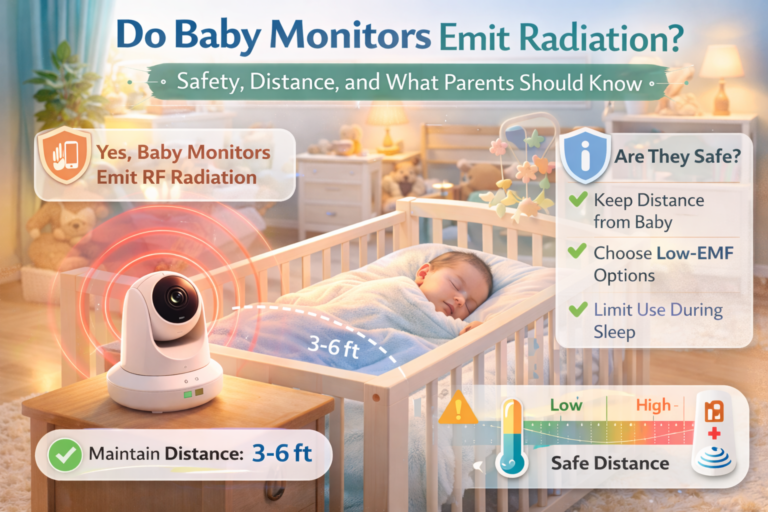
Baby monitor radiation refers to the radiofrequency (RF) signals that wireless devices use to transmit audio and video.
These signals are:
- Non-ionizing radiation
- The same type used by WiFi routers, phones, and Bluetooth devices
- Not strong enough to damage DNA or cells
This is very different from harmful ionizing radiation like X-rays.
How Much Radiation Do Baby Monitors Emit?
Most baby monitors emit extremely low levels of radiation, often far below safety limits set by international health organizations.
In general:
- WiFi baby monitors emit similar radiation to smartphones or routers
- Non-WiFi monitors using FHSS or DECT usually emit even less
- The signal strength decreases rapidly with distance
The further the camera is from your baby, the lower the exposure.
Are WiFi Baby Monitors More Risky?
WiFi baby monitors usually transmit data more frequently and over longer distances, which means they may emit slightly more RF energy compared to closed-loop systems.
However, even these levels are still well within accepted safety standards when used properly.
That said, many parents prefer non-WiFi baby monitors simply to minimize unnecessary wireless exposure.
How to Reduce Baby Monitor Radiation Exposure
If you’re concerned about baby monitor radiation, you can take simple steps to reduce exposure:
- Place the camera at least 3–6 feet away from the crib
- Avoid mounting the camera directly above the baby’s head
- Turn off unused wireless features
- Consider using a non-WiFi baby monitor
Distance is the most effective way to reduce exposure.
What Do Health Organizations Say?
Major health organizations agree that the levels of RF radiation from consumer devices like baby monitors are safe when used as intended.
There is currently no strong scientific evidence linking baby monitors to health problems when used properly.
Are Wired Baby Monitors Safer?
Wired monitors emit no wireless radiation, but they are less practical and much less common today.
For most parents, a well-placed non-WiFi wireless monitor offers the best balance of safety, convenience, and peace of mind.
Should Parents Be Worried?
Baby monitor radiation sounds scary, but in reality, the exposure is very low and well below dangerous levels.
By using your monitor correctly and choosing the right type, you can minimize any potential risk even further.
Final Thoughts
Baby monitors are designed to be safe, and the radiation they emit is minimal. If you want the lowest possible exposure, choose a non-WiFi monitor and place it at a reasonable distance from your baby’s crib.