FHSS vs DECT Baby Monitor: What’s the Difference and Which One Is Better?
When comparing an FHSS vs DECT baby monitor, the real question is not just which technology sounds better. It is which one actually fits the way you want to monitor your baby at home.
FHSS and DECT are both wireless technologies used in non WiFi baby monitors. Both can offer strong privacy, stable connections, and reliable everyday performance. But they are not built for exactly the same purpose.
FHSS is more common in modern video baby monitors because it can support both audio and video while keeping the signal private and resistant to interference. DECT is more common in audio only monitors, where clear sound, simplicity, and signal stability matter most.
In this guide, we’ll explain the difference between FHSS and DECT baby monitors in plain English, compare their strengths and weaknesses, and help you decide which one makes more sense for your home, your baby, and your comfort level as a parent.
Quick Answer: FHSS vs DECT Baby Monitor
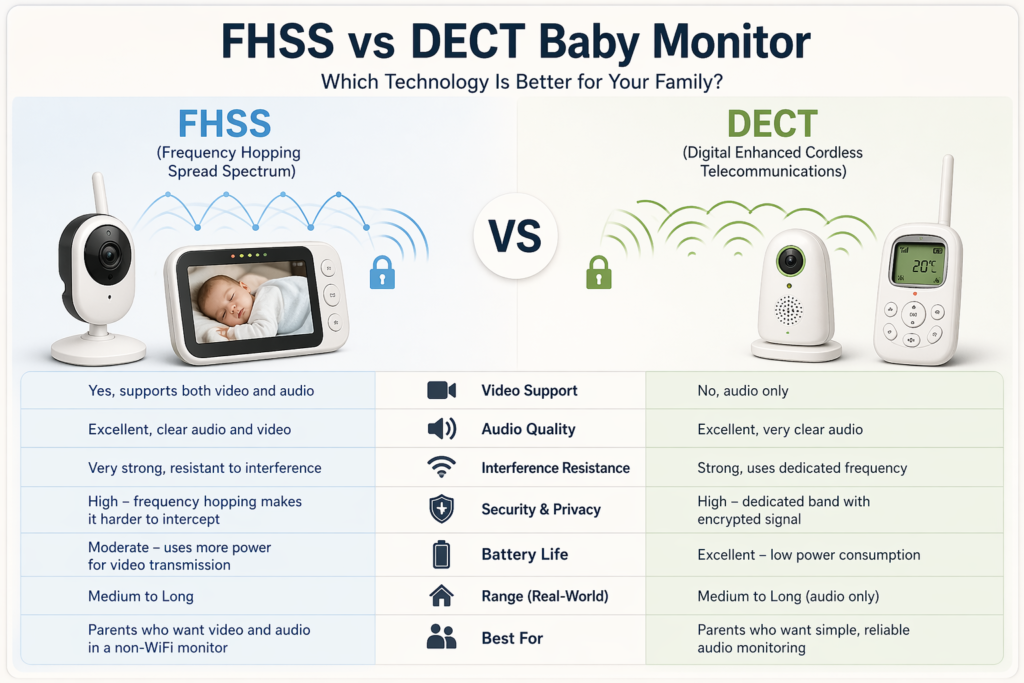
FHSS is usually the better choice if you want a non WiFi video baby monitor with both picture and sound. It is widely used in modern parent unit monitors because it supports secure video transmission and handles interference well.
DECT is usually the better choice if you only need an audio baby monitor. It is known for clear sound, stable connection, and simple setup.
For most parents today, FHSS is the more practical choice for video monitoring, while DECT remains an excellent option for audio only monitoring.
What is FHSS?
FHSS stands for Frequency Hopping Spread Spectrum. In simple terms, it means the baby monitor does not stay on one fixed channel. Instead, it rapidly switches between different frequencies while sending audio or video from the camera to the parent unit.
This makes the signal harder to intercept and less likely to be disrupted by other wireless devices in your home.
For parents, the benefit is simple. FHSS can provide a private, stable connection without needing WiFi, an app, or cloud access. That is why many modern non WiFi video baby monitors use FHSS technology.
FHSS is especially useful if you want a dedicated baby monitor with a screen, rather than using your phone. It is also a strong option for parents who want video monitoring but prefer to avoid internet connected cameras.
🔹 Benefits of FHSS baby monitors:
- Very good privacy and security
- Less interference from Wi-Fi, Bluetooth, and other devices
- Stable connection in apartments and crowded areas
- Widely used in non-WiFi baby monitors
🔹 Downsides of FHSS:
- Slightly more complex technology
- Quality depends on the implementation and hardware quality
What is DECT?
DECT stands for Digital Enhanced Cordless Telecommunications. It is a wireless technology originally designed for cordless phones, but it is also widely used in baby monitors, especially audio only models.
Unlike standard wireless signals that can be affected by everyday devices, DECT operates on a dedicated frequency band. This helps reduce interference from WiFi networks, smartphones, and other electronics in your home.
For parents, the main advantage of DECT is clear and consistent audio. It is known for delivering stable sound quality with very little background noise or signal dropouts, even in homes with multiple devices.
DECT is most commonly used in audio baby monitors rather than video models. It does not support video transmission the same way FHSS does, but it excels at what it is designed for, which is reliable, real time audio monitoring.
If your priority is hearing your baby clearly without dealing with apps, screens, or internet connections, a DECT baby monitor can be a simple and dependable choice.
🔹 Benefits of DECT baby monitors:
- Very stable and reliable connection
- Excellent audio quality
- Good protection against eavesdropping
- Low interference from other household devices
🔹 Downsides of DECT:
- Mostly used for audio-only baby monitors
- Fewer video models use DECT
- Less flexible compared to FHSS for video transmission
FHSS VS DECT: SIDE-BY-SIDE COMPARISON
| Feature | FHSS | DECT |
|---|---|---|
| Security | Very high | Very high |
| Interference resistance | Excellent | Excellent |
| Audio quality | Very good | Excellent |
| Video support | Yes | Rare |
| Range | Very good | Very good |
| WiFi required | No | No |
| Best for | Video + audio monitors | Audio-only monitors |
WHICH ONE IS MORE SECURE?
Both FHSS and DECT baby monitors are considered secure options, especially compared to WiFi based cameras. Since neither relies on an internet connection, the risk of remote access from outside your home is significantly lower.
FHSS improves security by constantly switching between frequencies while transmitting audio or video. This makes it very difficult for signals to be intercepted or disrupted.
DECT takes a different approach. It uses a dedicated frequency band that is separate from most common household devices. This reduces interference and also limits the chances of unauthorized access.
In real world use, both technologies provide a high level of privacy for parents who want a closed system that does not connect to the internet.
The choice between them is less about security and more about how you plan to use your monitor. If you want video with a secure connection, FHSS is the better fit. If you only need clear and reliable audio, DECT offers a simple and very stable solution.
For parents who want to avoid internet connected devices altogether, both FHSS and DECT are strong alternatives to WiFi baby monitors.
FHSS vs DECT: Which Should You Choose?
Choosing between an FHSS vs DECT baby monitor comes down to one simple question. Do you need video or just audio?
If you want to see your baby, an FHSS baby monitor is the better choice. This technology is widely used in modern video monitors because it supports both audio and video while keeping the connection private and stable. It is a strong option for parents who want a dedicated screen without relying on WiFi or mobile apps.
If you only need to hear your baby, a DECT baby monitor can be the better fit. It is known for clear sound, simple setup, and reliable performance, especially in homes with multiple wireless devices.
For most parents today, FHSS is the more practical choice because video monitoring has become the standard. It gives you both visibility and audio in one device, without adding the complexity of internet connected cameras.
DECT still makes sense in specific situations. It is ideal if you prefer a minimal setup, want longer battery life, or simply do not need a screen.
If you are comparing real models that use FHSS technology, especially non WiFi video monitors, you can also explore our guide to the best baby monitors without WiFi to see which options perform best in everyday use.
In the end, both FHSS and DECT are safe, reliable technologies. The right choice depends on how you want to monitor your baby and what gives you the most confidence during the day and at night.
Real-World Recommendation: What Actually Works for Parents
When comparing FHSS vs DECT baby monitors, the technical differences matter, but what matters more is how these technologies perform in everyday life.
In real homes, most parents end up choosing FHSS monitors for one simple reason. They want to see their baby, not just hear them. FHSS supports both video and audio in a closed system, without relying on WiFi, which makes it the most practical option for modern monitoring.
FHSS monitors are especially useful if you:
- want a dedicated screen instead of using your phone
- need to monitor your baby during naps and overnight
- prefer a private, non WiFi setup with stable video
Many popular non WiFi video monitors use FHSS because it provides a reliable connection and resists interference by constantly switching frequencies ()
DECT, on the other hand, is best suited for simpler setups.
It makes sense if you:
- only need clear audio monitoring
- prefer a minimal device with longer battery life
- want something very easy to use with no extra features
DECT is known for strong, interference resistant audio transmission, which is why it is still widely used in audio baby monitors.
For most parents today, the decision is straightforward.
If you want a complete monitoring setup with both video and sound, FHSS is the better and more practical choice.
If you prefer simplicity and only need to hear your baby, DECT remains a reliable and stable option.
Both technologies are safe, private, and do not rely on the internet. The right choice depends on how you want to use your monitor and what gives you the most confidence during the day and at night.
Frequently Asked Questions
Is FHSS better than DECT for baby monitors?
FHSS is usually the better choice if you want a video baby monitor. It supports both video and audio while maintaining a private, non WiFi connection. DECT is better suited for audio only monitoring, where clear sound and simplicity are the priority.
Are FHSS baby monitors safe from hacking?
FHSS baby monitors are considered very safe because they do not connect to the internet. They use a direct signal between the camera and the parent unit, which makes remote access extremely unlikely.
Do DECT baby monitors have video?
No, DECT baby monitors are almost always audio only. The technology is optimized for clear and stable sound, not for transmitting video.
Which baby monitor technology has better range?
Both FHSS and DECT can offer strong range, but real world performance depends on your home. Walls, floors, and interference can reduce signal strength. FHSS monitors often perform better in video setups, while DECT is known for stable audio over distance.
Is FHSS safer than WiFi baby monitors?
FHSS monitors are often preferred by parents who want a more private setup. Since they do not rely on the internet, they avoid many of the security concerns associated with WiFi cameras.
Which is better for large homes, FHSS or DECT?
FHSS is usually the better choice for large homes if you need video monitoring. It is designed to handle both audio and video transmission across multiple rooms. DECT can also perform well, but it is limited to audio only use.
Do I need DECT if I already have an FHSS monitor?
No, most parents do not need both. An FHSS monitor already covers both video and audio needs. DECT is only useful if you specifically want a simple audio only backup or prefer a minimal setup.
Final Verdict: FHSS vs DECT Baby Monitor
BoIf you are deciding between an FHSS vs DECT baby monitor, the answer is simpler than it may seem.
For most parents, an FHSS baby monitor is the better choice. It supports both video and audio, offers a private connection without WiFi, and fits the way modern parents monitor their baby throughout the day and night.
DECT still has its place. It is a strong option if you only need audio monitoring and prefer a simple, no screen setup with clear and stable sound.
Both technologies are safe, reliable, and do not rely on the internet. The difference is not about which one is better overall, but which one matches your needs.
If you want a complete monitoring solution with video and sound, FHSS is the more practical and flexible option.
If you want a basic and dependable audio only monitor, DECT remains a solid choice.
Choosing the right one comes down to how you want to monitor your baby and what gives you the most confidence at home.
If you’re looking for the best non-WiFi options, check out our guide to the Best Baby Monitor Without WiFi.