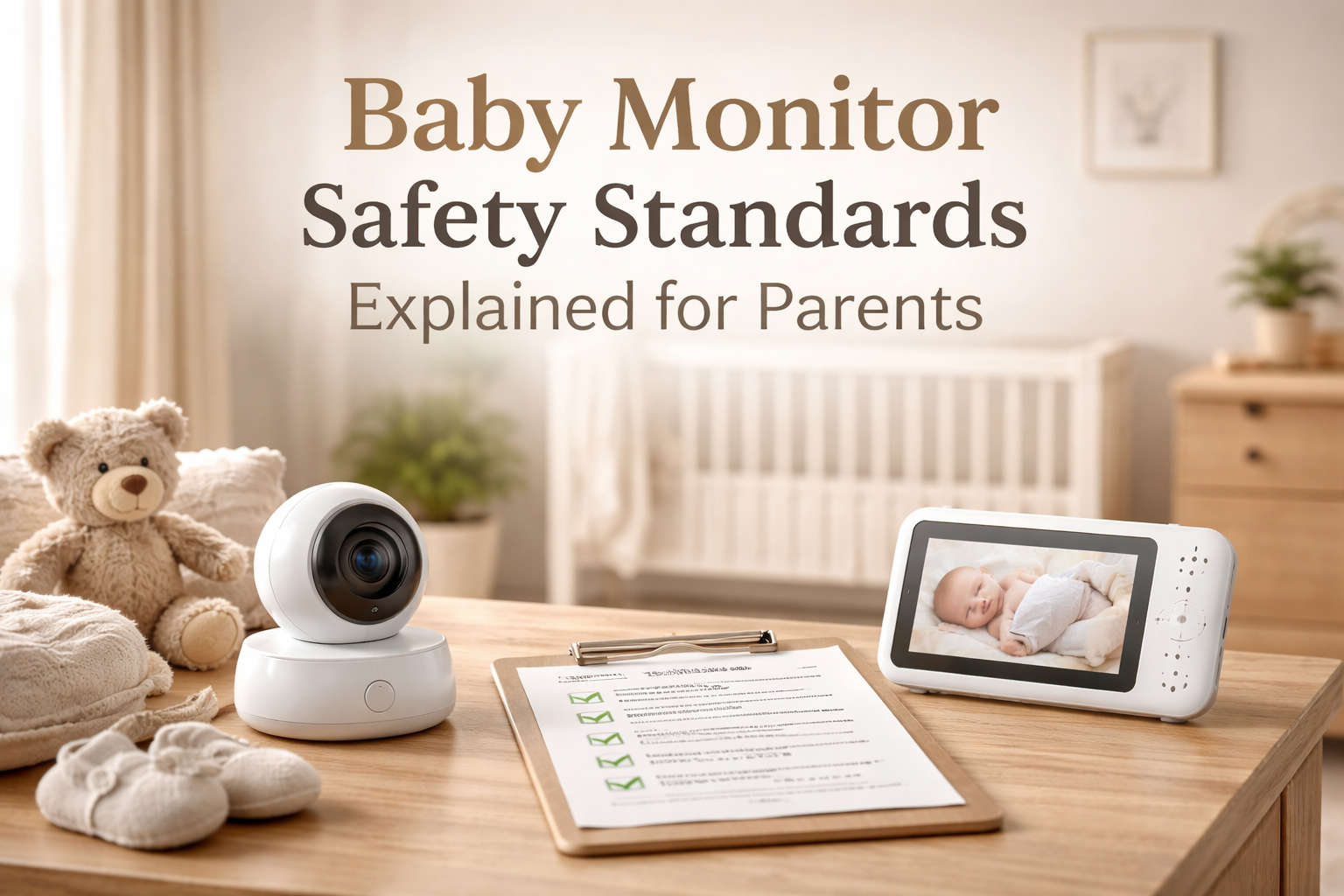
Baby Monitor Safety Standards Explained for Parents
Baby monitor safety standards sound reassuring on the surface. If a product is sold in the United States, it must be safe… right?
Most of the time, yes. But “safe” doesn’t mean perfect. And it definitely doesn’t mean risk-free.
When parents start researching baby monitors, they quickly encounter words like FCC-certified, compliant, radiation limits, encryption, and secure transmission. For many families especially first-time parents that language creates more anxiety than clarity.
Is WiFi unsafe?
Are non-WiFi monitors better?
Do newer monitors emit less radiation?
Are older models risky?
The good news is this: modern baby monitors sold by reputable retailers must meet baseline regulatory requirements. The better news? Once you understand what those standards actually cover and what they don’t you can make decisions calmly instead of fearfully.
Because safety isn’t just about emissions. It’s also about placement, cords, electrical quality, and realistic expectations.
If you’ve already read our deep dive on Baby Monitor Radiation: Should Parents Be Concerned?, you know that most fears stem from misunderstanding how RF energy works in everyday devices. This article goes one level deeper into what official standards actually mean for your baby’s nursery.
What Do Baby Monitor Safety Standards Actually Regulate?
In the United States, baby monitors must comply with several federal and industry regulations before they can be legally sold.
The most relevant include:
- FCC regulations (Federal Communications Commission) – These govern radiofrequency emissions and ensure the device does not exceed safe exposure limits.
- Electrical safety standards (often UL or ETL listed) – These focus on overheating prevention, fire safety, and wiring integrity.
- Consumer product safety requirements (CPSIA) – Broader child product safety compliance.
Here’s what that means in practical terms:
A certified baby monitor must operate within federally accepted RF exposure limits. It must not interfere dangerously with other electronics. And it must meet electrical safety guidelines designed to prevent overheating and short circuits under normal use.
That’s the baseline.
But safety standards don’t regulate how you mount the camera. They don’t guarantee perfect WiFi encryption. And they don’t eliminate all risks if cords are improperly positioned.
Standards create guardrails. Safe usage completes the picture.
Are All Baby Monitors Equally Safe?
From a regulatory standpoint, most monitors from established brands meet minimum safety requirements.
Where differences appear is in:
- Build quality
- Long-term durability
- Data encryption (for WiFi models)
- Firmware update policies
- Cord design and mounting systems
For example, WiFi baby monitors rely heavily on encryption and software security. If you’re unsure whether WiFi is necessary in your home, our guide on Do Baby Monitors Need WiFi? explains the privacy versus convenience tradeoff in detail.
Non-WiFi monitors remove many cybersecurity concerns entirely because they use direct FHSS transmission instead of internet connectivity. For some parents, that simplicity feels inherently safer even though both types operate within regulated RF limits.
Safety isn’t just about emissions. It’s about the full ecosystem of how the device functions.
RF Exposure: What the Standards Actually Mean
Radiofrequency energy sounds alarming when discussed without context. But baby monitors emit RF levels similar to WiFi routers, cordless phones, and Bluetooth devices.
The FCC sets exposure limits designed to stay well below levels considered harmful.
So why do some parents still worry?
Because baby monitors are used for long periods often 10–12 hours a night.
If you want to minimize exposure further (even though devices already meet standards), simple placement decisions make the biggest difference:
- Keep the camera at least 3 feet away from the crib
- Avoid mounting directly above your baby’s head
- Turn off continuous streaming if not necessary
- Choose non-WiFi models if you prefer fewer connected devices
Distance reduces exposure far more than switching brands.
And if you want a detailed breakdown of how range, signal strength, and RF transmission actually interact, our Baby Monitor Range Guide explains why advertised range numbers don’t equal increased exposure risk.
Electrical Safety: The Overlooked Risk
Parents often fixate on radiation while overlooking the more immediate risk: cords and power supplies.
A baby monitor is an electrical device plugged in near a crib. That matters more than signal type.
Important safety checks:
- Ensure the monitor carries recognized certification markings
- Keep cords fully out of reach of the crib
- Avoid extension cords when possible
- Do not use third-party replacement adapters unless manufacturer-approved
- Ensure airflow around the camera to prevent heat buildup
Cords pose a documented strangulation risk if improperly positioned. Radiation fears, by comparison, are often exaggerated relative to real-world electrical hazards.
Safe placement matters more than brand debates.
WiFi Security as a Safety Issue
In 2026, “safety” also includes data security.
For WiFi monitors, look for:
- Encrypted transmission
- Two-factor authentication
- Regular firmware updates
- Clear privacy policies
- The option to disable cloud storage
Most hacking concerns stem from weak passwords or unsecured routers not from the monitor hardware itself.
If cybersecurity stress keeps you awake at night, a non-WiFi monitor may offer peace of mind simply by reducing digital exposure.
What Safety Standards Don’t Guarantee
It’s important to understand what certifications do not promise.
They don’t guarantee:
- Zero signal drop
- Instant audio response
- Immunity from interference
- Perfect app stability
- Lifetime durability
Safety standards focus on preventing harm not ensuring flawless performance.
That’s a crucial distinction when reading reviews.
Common Safety Mistakes Parents Make
Even a certified monitor can become unsafe if misused.
The most common issues aren’t about emissions at all:
- Mounting directly above the crib
- Letting cords hang within reach
- Placing cameras on unstable shelves
- Ignoring overheating signs
- Using outdated firmware for WiFi models
- Placing monitors too close to reduce “radiation” without realizing distance already matters
One exhausted parent once angled a monitor too steeply from a nearby dresser. It slipped overnight. Nothing happened but the placement itself created the risk.
Safety is rarely about the device alone. It’s about the setup.
How to Choose a Monitor with Safety in Mind
If safety is your primary concern, focus on:
- Established brands with visible certifications
- Clear documentation of compliance
- Simple placement options
- Secure mounting systems
- Privacy controls (if WiFi-enabled)
And remember: more features don’t automatically equal more safety.
Sometimes the safest monitor is the one that works reliably without requiring constant adjustment.
FAQ: Baby Monitor Safety Standards
Are baby monitors regulated in the United States?
Yes. They must comply with FCC regulations regarding RF emissions and typically meet recognized electrical safety standards such as UL or ETL certification.
Do baby monitors emit harmful radiation?
They emit low-level RF energy within federally accepted safety limits. Proper placement further reduces exposure.
Is a non-WiFi baby monitor safer?
From a privacy perspective, yes it avoids internet connectivity. From an RF standpoint, both WiFi and non-WiFi models operate within regulated limits.
Can baby monitors overheat?
Rarely, but any electrical device can if damaged or improperly ventilated. Always ensure airflow and use approved power adapters.
Is it unsafe to mount the camera above the crib?
Yes. The safest setup keeps the camera at least 3 feet away and angled toward the crib.
Do newer monitors have stricter safety standards?
Regulations evolve over time, but all currently sold monitors must meet existing federal requirements.
Should I worry about long-term exposure?
Current scientific consensus indicates exposure from compliant devices is within accepted safety margins. Placement and reasonable distance remain the most practical precautions.
Final Thoughts
Baby monitor safety standards exist to protect families—not to create new fears.
If you:
- Choose a certified product
- Mount it safely
- Keep cords fully out of reach
- Maintain secure passwords (for WiFi models)
- Update firmware when required
You are already doing what responsible parents do.
A safe nursery isn’t built on perfect technology. It’s built on thoughtful setup.
Always follow safe sleep guidelines, position monitors securely away from the crib, and keep all cords completely out of reach.