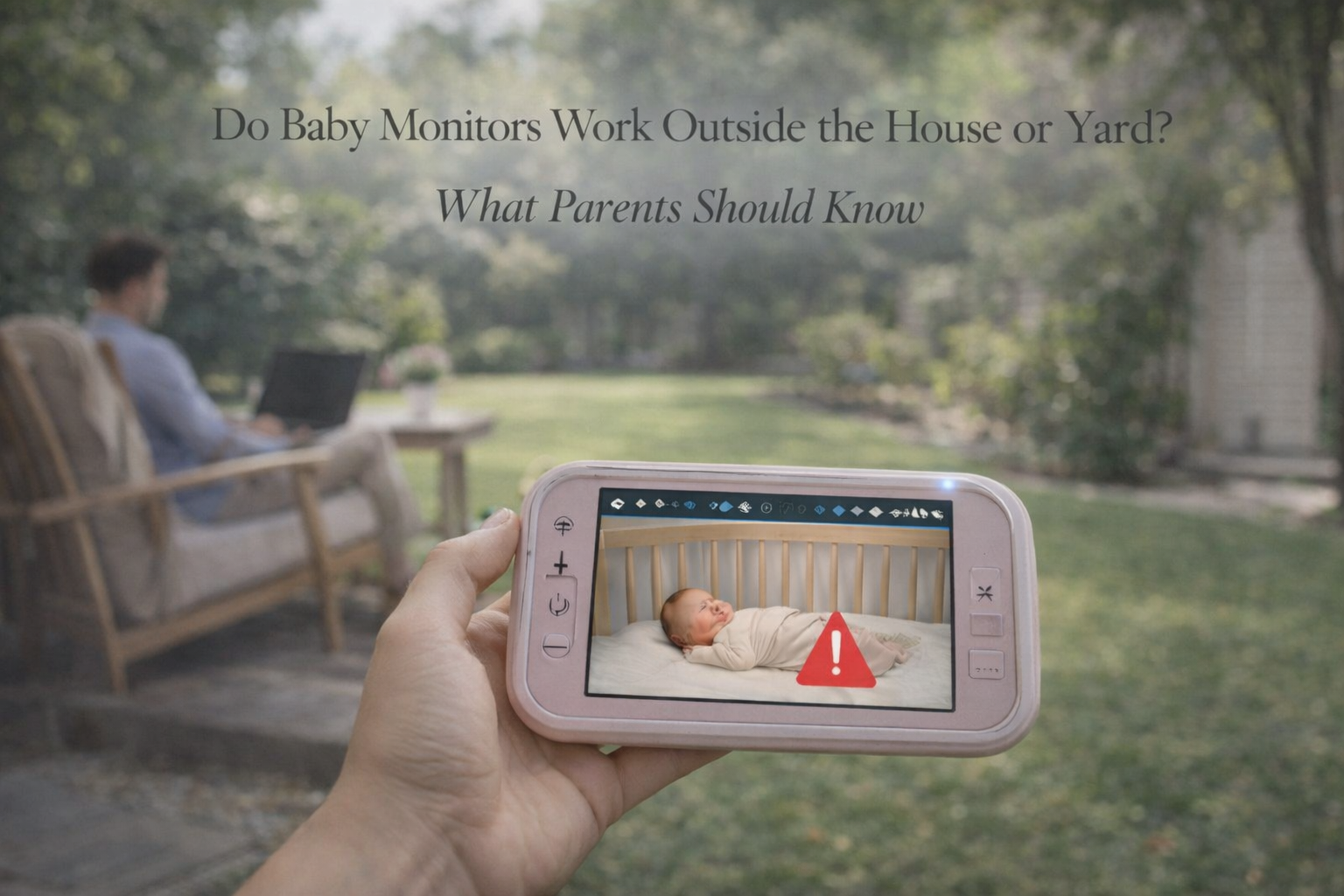
Do Baby Monitors Work Outside the House or Yard? What Parents Should Know
Do baby monitors work outside? It’s one of the most practical questions parents ask and one of the most misunderstood. Because the truth is, most parents aren’t trying to monitor their baby from 1,000 feet away in an open field. They’re trying to do something normal: sit on the patio, water the garden, take out the trash, talk to a neighbor for two minutes, or enjoy a quiet coffee in the backyard while the baby naps.
On paper, many baby monitors claim impressive range. Some advertise 800 feet, 1,000 feet, or even 1,500 feet. Those numbers sound like you should be able to walk anywhere around your property without issues.
But real homes are not range test labs. Exterior walls, windows, insulation, and even the layout of your yard can dramatically reduce performance. Many parents find that a monitor works perfectly indoors but starts cutting out the moment they step outside.
That can be frustrating and in some cases, it can change how parents use their home. If you’re afraid the monitor will drop signal, you may avoid being outside altogether, even when fresh air would actually help you feel better during those long newborn months.
This guide explains whether baby monitors work outside, what affects outdoor performance, what “range” actually means in real-world terms, and how to choose the right type of monitor if you want reliable monitoring in a yard, patio, balcony, or driveway.
Do Baby Monitors Work Outside the House?
Yes, many baby monitors do work outside the house but reliability depends on the type of monitor and how far you are from the baby unit.
Most baby monitors can handle basic outdoor use such as:
- sitting on a patio right outside the nursery wall
- being in a backyard near the house
- stepping into the driveway
- walking to the mailbox in front of the house
However, problems become more common when:
- you move farther away
- there are thick exterior walls
- the baby unit is positioned deep inside the home
- the yard has obstacles (garage walls, trees, fences)
- your monitor relies on WiFi and your outdoor WiFi coverage is weak
So the answer isn’t simply yes or no. It’s “yes, but with realistic limitations.”
Why Baby Monitor Range Claims Are So Misleading
Most range numbers printed on baby monitor packaging are based on line-of-sight testing. That means the baby unit and parent unit are tested outdoors, facing each other, with no walls or obstacles.
That’s not how parents use baby monitors.
In real life, outdoor monitoring involves at least one major obstacle: your house.
The signal has to travel:
- from the nursery
- through an interior wall
- through an exterior wall (often thicker)
- through a window or door frame
- across the yard
- and into your parent unit or phone
That is a very different scenario than an open-field test.
Even the best baby monitor can lose most of its range once it has to pass through a solid exterior wall.
This is why a monitor advertised as “1,000 feet” might only work 50–150 feet outside depending on construction.
What Reduces Baby Monitor Signal Outdoors?
Several factors affect outdoor performance, and parents are often surprised by what matters most.
Exterior Walls Are the Biggest Signal Killer
Exterior walls are usually thicker than interior walls. They often contain:
- brick or stone
- insulation layers
- foil-backed materials
- concrete reinforcement
- metal framing
- heavy windows or shutters
Any metal inside the wall can weaken radio signals dramatically.
If the nursery wall faces the yard directly, you may get better performance. But if the nursery is in the middle of the house, the signal has to pass through multiple walls before it even reaches the outside.
This is why two families can have the same monitor and completely different experiences.
Windows Can Help or Hurt
Glass is generally easier for signals to pass through than brick. If your baby unit is near a window, the signal may travel better outside.
But some modern windows have coatings designed for insulation. These coatings can reduce wireless signal penetration.
If your monitor works better when the window is open, that’s a strong sign that the window materials are affecting signal strength.
Doors and Metal Frames Reduce Range
A patio door seems like a small obstacle, but metal door frames and thick insulated doors can weaken signals.
Many parents notice their monitor works fine just inside the house but disconnects the moment they step outside through the door.
This happens because the door structure blocks the signal more than expected.
Outdoor Obstacles Matter More Than You Think
Outside, signal is affected by physical objects such as:
- garages
- sheds
- fences
- trees
- hills
- parked vehicles
If you walk behind a garage wall or stand in a spot where the signal must “bend” around the house, performance drops.
Baby monitor signals travel best when they have a clear path.
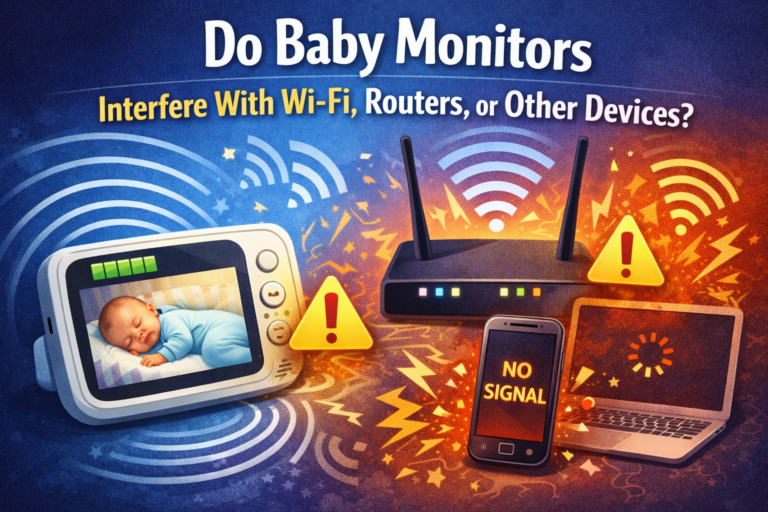
Interference From WiFi and Other Devices
Outdoor use often increases interference because your monitor may compete with:
- outdoor security cameras
- WiFi extenders
- neighbor WiFi networks
- Bluetooth speakers
- smart outdoor lighting systems
This is especially true in neighborhoods with many routers.
If you want a deeper breakdown of how baby monitors interact with WiFi congestion and other electronics, your post Can Baby Monitors Interfere With WiFi or Other Devices? is a perfect internal link here because it explains the interference problem clearly for parents.
WiFi vs Non-WiFi Baby Monitors: Which Works Better Outside?
This is the most important question for parents who want outdoor monitoring.
Non-WiFi Monitors (FHSS): Often Better for Backyard Use
Non-WiFi baby monitors use a dedicated parent unit. They communicate directly with the baby camera.
These monitors are often more reliable outside because they don’t depend on your home WiFi network. If your WiFi coverage outside is weak, a WiFi monitor may struggle, but an FHSS monitor can still work.
However, FHSS monitors still face the same physical obstacles: exterior walls and distance.
The advantage is predictability. If you’re within range, it works. If you’re not, it doesn’t.
There is no buffering or WiFi lag. It’s usually instant audio and video until signal drops.
This is why many parents who want reliable monitoring for patios and yards prefer non-WiFi systems.
WiFi Monitors: Great If Your Outdoor WiFi Is Strong
WiFi monitors can work extremely well outside even far away if your WiFi signal extends into the yard.
If you have a mesh WiFi system, outdoor access point, or strong router placement, you may be able to monitor your baby from anywhere in your yard.
WiFi monitors also allow you to monitor from your phone, which can feel more convenient than carrying a separate parent unit.
But WiFi monitors have a weakness: if your outdoor WiFi signal is inconsistent, the monitor may lag or disconnect.
Some parents experience the frustrating scenario where the monitor works indoors perfectly but becomes unreliable outside because their WiFi coverage drops the moment they step outdoors.
This is not always the monitor’s fault. It’s often a WiFi coverage issue.
Why Parents Often Prefer Non-WiFi for Outdoor Monitoring
Many parents assume WiFi is automatically better for outdoor range. But in real life, non-WiFi monitors often feel more reliable for simple backyard use.
That’s because they avoid:
- router congestion
- app buffering
- phone notification delays
- WiFi dead zones outside
This is exactly why your money page Best Baby Monitor Without WiFi fits naturally into this topic. Parents searching “do baby monitors work outside” often discover they want a monitor that doesn’t depend on their internet setup.
For many families, the simplest solution is the best one.
How Far Will a Baby Monitor Work Outside in Real Life?
This is the question parents really care about.
The honest answer is that most baby monitors can work outside within a limited range, often around:
- 20–60 feet reliably through exterior walls
- 50–150 feet in favorable conditions
- more if the baby unit is near a window or exterior wall
- less if the nursery is deep inside the home
A monitor might claim 1,000 feet, but outdoor range through walls is often a fraction of that.
If you live in an apartment with a balcony directly outside the nursery, you may get excellent results.
If you live in a house with thick brick walls and the nursery is upstairs on the opposite side, outdoor performance may be poor even at short distances.
This is why testing matters more than marketing numbers.
Can You Use a Baby Monitor in the Yard While the Baby Sleeps Upstairs?
Yes, but multi-floor monitoring adds another barrier.
If your baby is upstairs and you’re outside, the signal must pass through:
- an upstairs interior wall
- the floor structure
- possibly multiple rooms
- an exterior wall
That’s a lot of obstacles.
Many monitors will struggle in this scenario unless:
- the camera is positioned well
- the home construction is light
- you stay close to the house
- you have strong WiFi coverage (for WiFi monitors)
If you want a detailed explanation of multi-floor monitoring reliability, your post Do Baby Monitors Work Upstairs and Downstairs? is an ideal internal link here, because it covers the exact scenario many parents face.
Common Outdoor Monitoring Problems Parents Report
Parents often describe outdoor monitoring problems in similar ways.
“It works inside but disconnects outside immediately”
This usually means exterior walls are blocking the signal or the monitor is right at its range limit.
“The video freezes but I can still hear sound”
Video requires more bandwidth than audio. This often happens when signal weakens slightly.
“It works on the patio but not in the driveway”
The driveway may require the signal to travel around the house or through a garage wall.
“My WiFi monitor works outside sometimes, but not consistently”
This often means outdoor WiFi coverage is unstable.
“It works until I close the door”
Doors, especially insulated or metal doors, can reduce signal dramatically.
How to Improve Baby Monitor Performance Outside
Parents can often improve outdoor reliability without buying a new monitor.
Move the Camera Closer to an Exterior Wall
If the camera is placed deep in the nursery, the signal has to pass through multiple walls before it even reaches outside.
Placing the camera on the wall closest to the yard can improve signal significantly.
Even a small shift in camera placement can change performance dramatically.
Mount the Camera Higher
Height matters.
Signals travel better when the camera is higher because there are fewer objects blocking transmission. A camera mounted high on the wall often provides stronger range than one sitting low on a dresser.
This also improves the viewing angle.
Keep the Parent Unit Away From Interference
If you’re using a non-WiFi parent unit outside, avoid standing near:
- outdoor speakers
- electrical panels
- metal fences
- large vehicles
Even if it sounds strange, metal objects can reflect and disrupt wireless signals.
Improve Outdoor WiFi Coverage (WiFi Monitors)
If you use a WiFi monitor and want reliable yard coverage, consider:
- mesh WiFi system
- WiFi extender
- outdoor access point
- router relocation closer to the yard side of the house
Many WiFi baby monitor problems are not monitor problems. They are WiFi coverage problems.
Use Lower Video Resolution (WiFi Monitors)
If your WiFi monitor app allows you to lower resolution, this can improve stability outdoors.
High-definition video consumes more bandwidth. When signal is weak, lowering quality can prevent freezing.
Understand Signal Drops and Test Your Real Limits
Parents often assume their monitor “should” work outside because of the advertised range.
But every home is different.
The best thing you can do is test.
Walk slowly outside while watching the monitor feed. Pay attention to where it starts freezing or lagging. That’s your real range.
Your related post How Often Do Baby Monitors Lose Signal (And Why) fits naturally here because it explains why signal drops happen and what parents can do to reduce them.
Is It Safe to Leave the Baby Inside While You’re Outside?
This is an emotional question as much as a practical one.
For many parents, sitting outside while the baby naps is one of the few peaceful moments of the day. Fresh air can reduce stress and help parents feel more human again.
If your monitor is reliable and you are close enough to respond quickly, it can be a safe and reasonable part of daily life.
But if your monitor signal is unstable outdoors, it may be better to stay within range or bring the baby closer (for example, a nap in a portable bassinet near the patio).
Parents should not rely on a monitor if it disconnects frequently. If the monitor is losing signal often, it can create false confidence.
If you’re using WiFi monitoring through a phone, also remember that notification settings matter. A phone on silent mode may not alert you properly.
This connects with your post Do Baby Monitors Need to Be On All Night?, because many parents underestimate how easily alerts can be missed if volume is low or the phone is not configured correctly.
What Kind of Monitor Is Best for Outdoor Use?
Parents who want outdoor monitoring usually fall into one of two categories:
Parents who want simple backyard reliability
For these parents, a non-WiFi FHSS monitor is often ideal. It provides stable connection without needing internet.
Parents who want monitoring anywhere (even away from home)
WiFi monitors are better for this, but they require strong WiFi coverage and good network security.
For parents who prioritize stability and privacy, non-WiFi monitors are often the better option, which is why your money page Best Baby Monitor Without WiFi is perfectly relevant here.
Final Thoughts
So, do baby monitors work outside the house or yard? In many cases, yes but only within realistic range limits.
Outdoor monitoring is affected by exterior walls, construction materials, distance, and interference. A monitor that claims 1,000 feet may still struggle if the signal must pass through thick brick walls or multiple floors.
Parents who want reliable yard use should focus less on advertised range numbers and more on real indoor-to-outdoor performance. Testing placement, improving WiFi coverage, or choosing a stable non-WiFi monitor can make the difference between constant frustration and real peace of mind.
For many families, the ability to sit outside for 20 minutes while the baby naps is not a luxury. It’s survival. With the right monitor setup, it’s absolutely possible.
FAQ
Do baby monitors work outside in the backyard?
Many baby monitors work outside in the backyard, especially close to the house. Range depends on exterior wall thickness, camera placement, and interference.
Why does my baby monitor lose signal when I step outside?
Exterior walls and doors can block wireless signals. Even a monitor with a long advertised range may lose signal quickly once it must transmit through brick, concrete, or insulated doors.
Are WiFi baby monitors better for outdoor use?
WiFi monitors can work well outside if your WiFi signal reaches the yard. If outdoor WiFi coverage is weak, a WiFi monitor may lag or disconnect.
How far can a baby monitor work outside?
In real homes, outdoor range is often 20–150 feet depending on construction and placement. Line-of-sight range numbers on packaging are usually much higher than real-world performance.
How can I improve baby monitor signal outside?
You can improve outdoor performance by mounting the camera higher, placing it closer to an exterior wall, reducing interference, lowering WiFi streaming quality, or improving WiFi coverage with a mesh system.