Baby Monitor Radiation: Should Parents Be Concerned?
Baby monitor radiation is one of those topics that tends to surface late at night, usually when a parent is already exhausted, scrolling through product reviews, and trying to make the “right” decision for their newborn. It often starts with a simple thought: This device is always on. It’s wireless. It’s close to my baby. Is that safe?
For many parents, the worry isn’t irrational. It’s a natural instinct to question anything electronic that sits near a sleeping newborn for hours at a time. And because baby monitors use wireless signals, the conversation quickly turns into concerns about EMF, RF exposure, and whether the monitor could affect a baby’s developing body.
The truth is that baby monitors do emit electromagnetic signals, but “radiation” is a broad word that often creates more fear than clarity. What matters is understanding what kind of radiation it is, how strong it is, and what practical steps parents can take to minimize unnecessary exposure without losing the benefits of monitoring.
This article explains what baby monitor radiation actually means, what science and safety guidelines suggest, and how parents can make reasonable, calm decisions that prioritize both safety and peace of mind.
What Parents Mean When They Say “Baby Monitor Radiation”
When parents talk about radiation from baby monitors, they are usually referring to RF radiation (radiofrequency energy), a type of electromagnetic field (EMF). This is the same general category of energy used by:
- WiFi routers
- smartphones
- Bluetooth headphones
- cordless phones
- smart home devices
RF energy is called “non-ionizing radiation,” which means it does not have enough energy to change DNA in the way that ionizing radiation (like X-rays or nuclear radiation) can.
That doesn’t mean parents shouldn’t care about exposure. It simply means the type of radiation involved is different than what many people imagine when they hear the word “radiation.”
Most baby monitor concerns are about long-term exposure, proximity, and whether a newborn’s developing nervous system might be more sensitive.
Do Baby Monitors Actually Emit Radiation?
Yes. Baby monitors emit electromagnetic signals when they transmit audio and video wirelessly.
But not all baby monitors emit the same amount, and not all transmit in the same way.
Some monitors transmit continuously. Others transmit only when sound is detected. Some use WiFi signals, while others use dedicated radio frequencies.
So the question isn’t whether they emit radiation. The question is: how much, and how close is the device to your baby?
What Types of Baby Monitors Emit the Most RF Energy?
The amount of RF energy depends on the technology used and how often the monitor is transmitting.
WiFi baby monitors
WiFi monitors tend to emit more RF energy than simple audio monitors because they transmit larger amounts of data, especially video.
If a WiFi camera streams continuously in HD, it is constantly sending data through your network. That means the transmitter is active frequently.
WiFi monitors also depend on your router, which itself emits RF signals continuously.
Non-WiFi video monitors (FHSS)
Many non-WiFi monitors use FHSS (Frequency-Hopping Spread Spectrum). They typically operate on 2.4 GHz, similar to WiFi, but the signal hops between channels.
FHSS monitors often have stable transmission and may reduce certain interference issues. They still emit RF energy, but the transmission style differs from WiFi.
Audio-only DECT monitors
DECT monitors typically operate around 1.9 GHz, which is separate from standard WiFi bands. DECT is often considered one of the more stable and lower-interference technologies for audio monitoring.
Many parents who are concerned about RF exposure prefer DECT audio monitors because they tend to have reliable range without heavy WiFi-style transmission.
Is Baby Monitor Radiation Dangerous for Newborns?
This is the core question, and it deserves a calm, balanced answer.
Most health authorities and mainstream pediatric guidance do not classify baby monitors as dangerous when used properly. They are widely used across millions of households, and there is no strong evidence showing that standard baby monitor RF exposure causes harm in typical use scenarios.
However, there is also an important reality: research on long-term low-level RF exposure is complex, and some parents prefer to take a precautionary approach, especially with newborns.
A reasonable approach is not panic. It’s smart placement and smart device choices.
Because RF exposure decreases sharply with distance, most practical safety comes down to how close the monitor is to your baby.
Distance Matters More Than Most Parents Realize
One of the most consistent findings across RF exposure discussions is that distance reduces exposure dramatically.
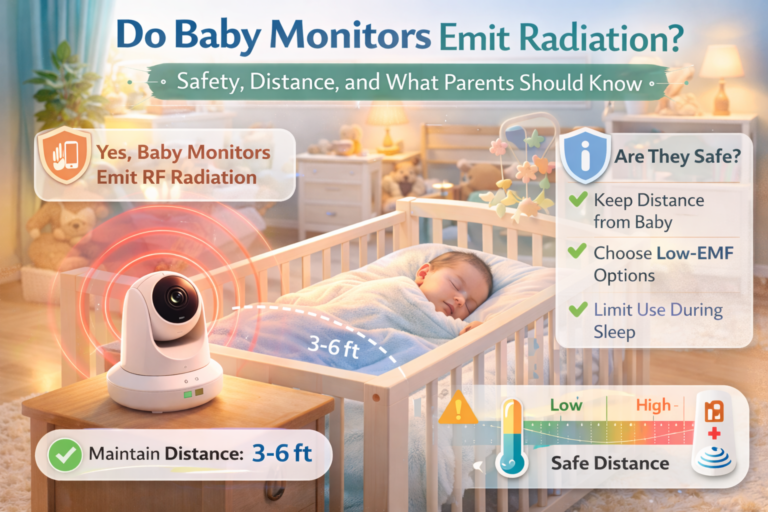
A baby monitor placed 6 inches from a baby’s head is very different from one placed 3 to 6 feet away.
That’s why many experts recommend keeping baby monitor cameras at least:
- 3 feet (about 1 meter) from the crib
- ideally mounted on a wall or shelf
Parents sometimes place a monitor on the crib rail or directly next to the baby for a better view. This is not recommended not only for RF exposure concerns, but also for physical safety reasons such as cords and falling devices.
Mounting the camera higher usually gives a better view and reduces direct exposure.
This is one of the easiest ways to reduce RF exposure without sacrificing monitoring.
Continuous Transmission vs Sound-Activated Transmission
Another important factor is whether your monitor transmits continuously.
Some monitors stream video and audio all the time. Others have a “VOX” or sound-activated mode where the monitor only transmits strongly when sound is detected.
If a monitor transmits continuously, RF output is active more consistently.
If the monitor transmits only when needed, overall exposure may be reduced.
Parents concerned about radiation may prefer sound-activated modes, especially during daytime naps when they don’t need constant monitoring.
However, sound-activated modes also come with trade-offs. If sensitivity is too low, parents may worry the monitor could miss early fussing.
Your post Can Baby Monitors Miss Crying? What Happens in Real Use is a strong internal link here, because it explains the real-life reliability of VOX modes and sensitivity settings.
What About the WiFi Router in the House?
Parents sometimes focus on the baby monitor camera but forget the router.
If you use a WiFi baby monitor, the router is constantly emitting signals and it may be located closer to the nursery than you realize.
Even if the baby monitor camera is positioned safely, the router might be in a hallway or nearby room, sending out strong 2.4 GHz and 5 GHz signals.
Parents who want to reduce RF exposure often choose non-WiFi monitors for this reason. A non-WiFi system doesn’t eliminate RF energy completely, but it avoids adding constant WiFi streaming to the home network.
This is one reason why many families search for non-WiFi models during the newborn stage.
Your money page Best Baby Monitor Without WiFi fits perfectly here because it targets parents who want a monitor that avoids internet-based transmission and reduces privacy and network concerns at the same time.
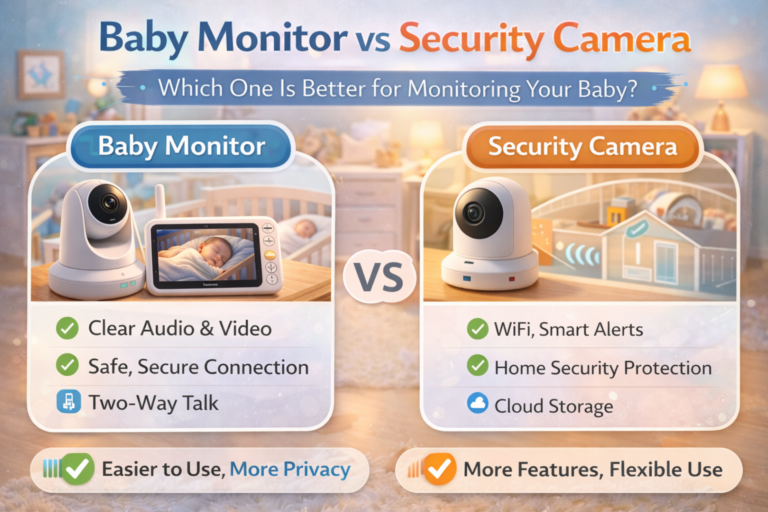
Are Non-WiFi Baby Monitors Safer Than WiFi Monitors?
Not necessarily “safer” in a medical sense, but many parents feel more comfortable with non-WiFi monitors because:
- they don’t depend on a router
- they don’t require cloud storage
- they reduce internet exposure
- they often feel simpler and less invasive
From a practical parenting perspective, non-WiFi monitors can also reduce anxiety. They often feel more stable, and they remove cybersecurity concerns.
For many families, the biggest “safety” issue isn’t RF exposure. It’s privacy and hacking.
If you want a full breakdown of monitor types, risks, and what matters most, your pillar page Baby Monitors: The Complete Guide for Parents is the most natural internal link here because it covers WiFi vs non-WiFi trade-offs in a broad, authoritative way.
Can Baby Monitor Radiation Affect Sleep?
Some parents worry that RF signals might disrupt sleep quality.
There is no strong evidence that baby monitors disrupt newborn sleep through RF exposure alone. However, baby monitors can disrupt sleep indirectly through:
- bright LEDs
- camera infrared lights
- clicking sounds when night vision activates
- parents reacting too frequently to normal newborn movement
In other words, the monitor is more likely to disturb sleep through its design and usage rather than radiation.
Newborn sleep is sensitive, and parents are often more anxious than they realize. If you’re checking the screen constantly or waking up for every grunt, the monitor may be increasing stress rather than reducing it.
This is where your pillar content Baby Sleep & Night Care: A Practical Guide for New Parents is relevant. It helps parents understand what is normal at night and how to create routines that allow everyone to rest more peacefully.
Practical Ways to Reduce Baby Monitor Radiation Exposure
Parents who want to reduce exposure can do so without extreme measures.
Place the camera at a safe distance
Mount it on the wall or place it on a shelf at least 3 feet away.
Avoid placing devices inside or on the crib
Never place the camera or audio unit on the crib rail. This also reduces cord hazards.
Use sound activation mode when appropriate
If your monitor supports VOX mode, using it during naps may reduce continuous transmission.
Avoid unnecessary WiFi devices in the nursery
Smart speakers, WiFi lights, and extra cameras add more RF sources.
Keep the router away from the nursery if possible
If you can, avoid placing the router directly on the other side of the nursery wall.
Choose non-WiFi monitoring if that helps you feel calmer
Many parents choose non-WiFi monitors for simplicity, privacy, and peace of mind.
What Parents Should Not Do (Common Mistakes)
Parents sometimes fall into extremes because they feel overwhelmed.
Here are common mistakes that don’t help:
- obsessively measuring EMF levels without context
- placing the camera too close just to get a “perfect view”
- turning off the monitor completely and losing peace of mind
- relying on unreliable third-party EMF products
- assuming “no WiFi” means “no RF energy”
The healthiest approach is balanced: reasonable distance, smart setup, and choosing a monitor you trust.
Is Baby Monitor Radiation a Bigger Concern Than Other Household Devices?
For most families, baby monitors are not the highest RF source in the home.
Smartphones, routers, tablets, laptops, and smart TVs often emit stronger or more frequent signals than a baby monitor, especially when streaming or downloading.
That doesn’t mean you should ignore baby monitor exposure. It means it should be placed into perspective.
A baby monitor is usually one of many RF sources in a modern home. The most effective reduction comes from good placement and limiting unnecessary devices near the crib.
Final Thoughts
Baby monitor radiation is a real thing in the sense that monitors emit RF energy, just like WiFi and Bluetooth devices. But in normal household use, baby monitors are generally considered safe, especially when placed at a reasonable distance from the crib.
Parents don’t need to panic or avoid monitors entirely. The smartest approach is practical: mount the camera away from the baby, secure cords, avoid unnecessary WiFi devices in the nursery, and choose a monitor type that matches your comfort level.
In the newborn stage, peace of mind matters. A monitor should support that not become another source of stress.
FAQ
Do baby monitors emit harmful radiation?
Baby monitors emit RF (radiofrequency) energy, which is non-ionizing radiation. There is no strong evidence that standard baby monitor exposure is harmful when used properly and placed at a safe distance.
How far should a baby monitor be from a newborn?
Most experts recommend placing a baby monitor camera at least 3 feet (about 1 meter) away from the crib. Wall-mounting is often the safest and most effective option.
Are WiFi baby monitors worse for radiation exposure?
WiFi monitors may transmit more frequently because they stream video data through your network. Parents concerned about exposure often prefer non-WiFi monitors, though both types emit RF signals.
Can baby monitor radiation affect a baby’s sleep?
There is no strong evidence that RF signals from monitors disrupt newborn sleep. Sleep disruption is more likely caused by monitor lights, sounds, or parents reacting to normal baby movement.
What is the safest type of baby monitor for parents worried about EMF?
Parents who want to reduce exposure often choose audio-only DECT monitors or non-WiFi video monitors and keep the camera positioned several feet away from the crib.