How Baby Monitors Actually Work (Without the Tech Jargon)
How baby monitors work is one of those topics that sounds more technical than it really is. Most parents don’t want a crash course in radio frequencies or network protocols they just want to know whether they’ll hear their baby cry, how far the signal reaches, and whether the monitor is safe and reliable at night. This article breaks it all down in plain English, focusing on what actually matters in real homes with real sleep routines.
What a Baby Monitor Really Is (At Its Core)
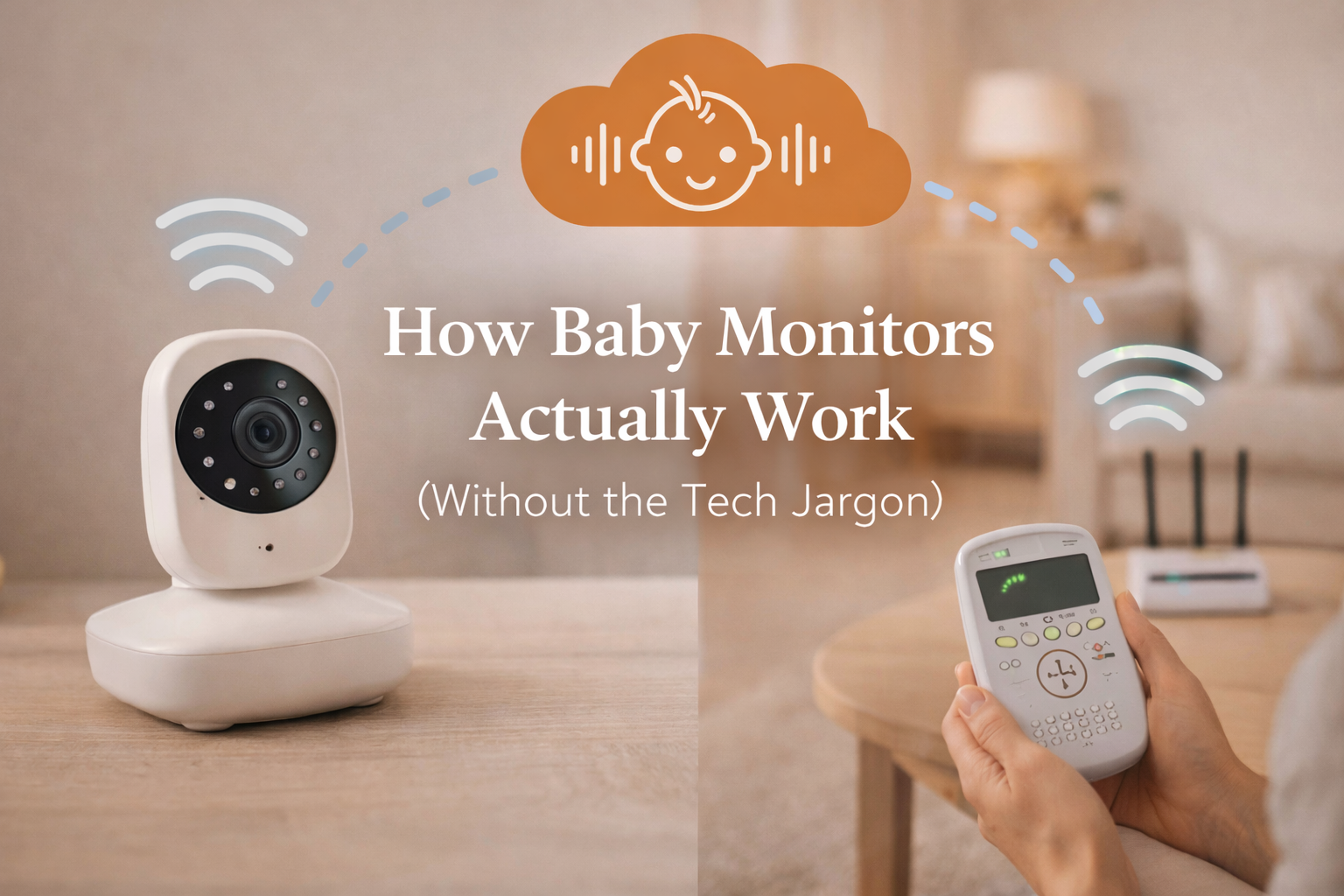
Strip away the marketing language and extra features, and every baby monitor comes down to the same basic idea: one device stays with your baby, and another stays with you. The baby unit listens and sometimes watches then sends that information to the parent unit.
That’s it.
Everything else video screens, smartphone apps, night vision, temperature alerts is built on top of this simple exchange. Understanding that core function makes it much easier to choose a monitor that fits your home and your parenting style.
How Baby Monitors Work in Practice
Audio: The Original Baby Monitor
Audio monitors are the simplest type, and they’ve been around for decades. A microphone in the baby unit picks up sound and sends it wirelessly to the parent unit’s speaker. When your baby cries, you hear it. When the room is quiet, the monitor stays silent or emits gentle background noise.
Because audio-only monitors don’t transmit video, they tend to have longer range, better battery life, and fewer connection issues. Many parents are surprised by how reliable these simpler models are, especially in larger homes or apartments with thick walls.
Video: Seeing as Well as Hearing
Video monitors add a camera to the baby unit and a screen to the parent unit (or an app on your phone). The camera captures live footage, often with infrared night vision so you can see in the dark, and sends it along with the audio signal.
This visual layer doesn’t replace listening it complements it. Parents often glance at the screen to check whether a sound is just normal movement or a sign their baby needs attention. That quick visual confirmation can reduce unnecessary trips into the nursery and help protect fragile sleep routines.
If your nights revolve around feeding schedules, room checks, and minimizing wake-ups, this kind of monitoring ties closely into broader sleep strategies discussed in guides like Baby Monitors: The Complete Guide for Parents, which covers how monitoring fits into nighttime care without becoming a source of anxiety.
How the Signal Gets From Room to Room
Non-WiFi (Direct Connection) Monitors
Many baby monitors use a direct radio connection between the baby unit and the parent unit. These are often labeled as FHSS or DECT monitors. You don’t need to understand the acronyms what matters is that the signal goes straight from one device to the other, without passing through the internet.
This type of connection tends to be:
- More stable in everyday use
- Less vulnerable to hacking
- Independent of your home WiFi
That’s why parents who value simplicity or live in areas with unreliable internet often prefer them. If you’re interested in this approach, our breakdown of the Best Baby Monitor Without WiFi explores why many families still choose non-WiFi models.
WiFi Monitors
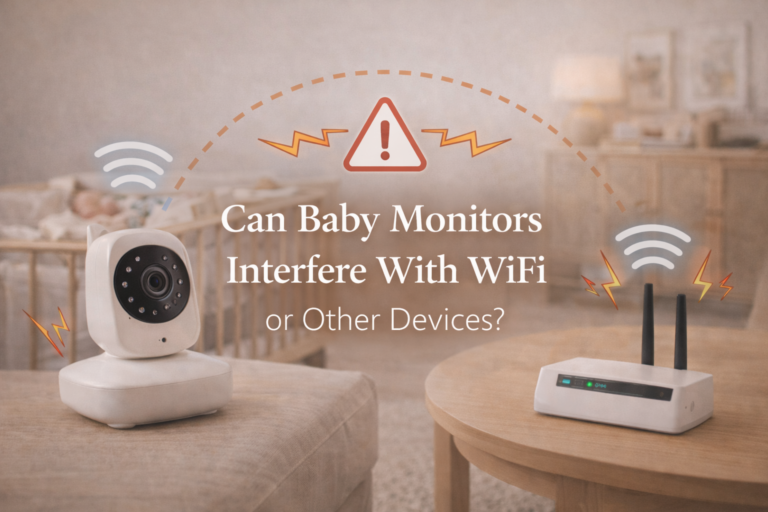
WiFi monitors work differently. Instead of sending the signal directly to a parent unit, the baby unit connects to your home WiFi network. The audio and video are sent through the internet to an app on your phone or tablet.
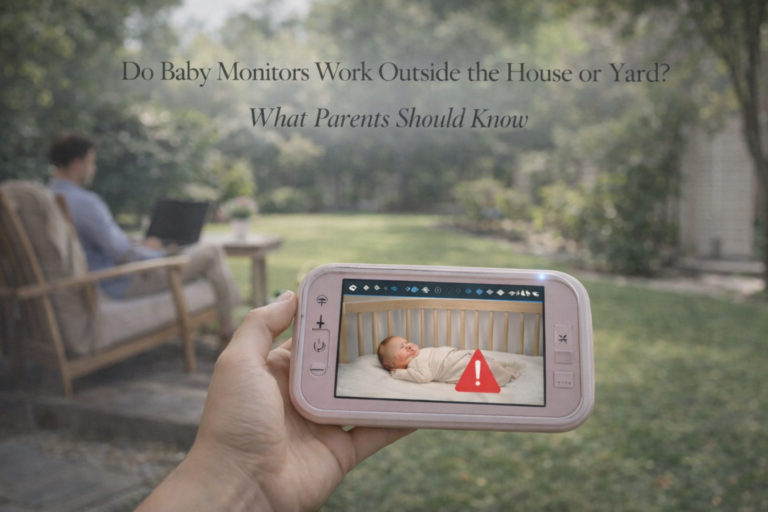
This setup allows you to check in from anywhere another room, the backyard, or even outside the house. The trade-off is that performance depends heavily on your WiFi quality. If the network is slow or unstable, the monitor may lag or disconnect.
For some parents, remote access is worth it. For others, especially during nighttime use, consistency matters more than flexibility.
Range: What “Up to 1,000 Feet” Actually Means
Monitor range claims can be misleading. When a box says “up to 1,000 feet,” that number usually refers to open space with no walls, doors, or interference. Real homes are very different.
Walls, floors, appliances, and even plumbing can weaken the signal. A monitor that promises long range might perform perfectly in a small apartment but struggle in a multi-story house with thick concrete walls.
The best way to think about range is not as a maximum number, but as a buffer. A monitor rated for longer distances often performs more reliably at shorter, real-world distances.
Why Night Vision Looks the Way It Does
If you’ve ever wondered why baby monitor video at night looks grainy or black-and-white, the answer is infrared light. The camera emits infrared LEDs that illuminate the room in a spectrum invisible to the human eye. The sensor then converts that reflected light into an image.
This system prioritizes visibility over aesthetics. You’re not meant to admire details you’re meant to see whether your baby is moving, sleeping, or standing up in the crib. Once you understand that, the look makes a lot more sense.
Sound Activation and “VOX” Explained Simply
Many monitors advertise sound activation or VOX mode. This doesn’t mean the monitor only works when your baby cries. It means the screen or audio stays quiet until sound crosses a certain threshold.
In practice, this saves battery life and reduces constant background noise. When your baby makes a meaningful sound, the monitor wakes up and alerts you. When things are calm, it stays unobtrusive an important detail for parents who already sleep lightly.
Are Baby Monitors Always On?
Most monitors are always listening, but not always transmitting at full power. Many adjust automatically based on sound levels or movement. This dynamic behavior is why modern monitors can last through the night on battery while still being responsive when it matters.
Understanding this helps explain why you might not hear every tiny shuffle but you’ll hear the sounds that count.
Safety and Privacy: What Actually Matters
Parents often worry about hacking, radiation, or whether monitors are “safe.” In practical terms, the biggest safety differences come down to connection type and basic usage habits.
Direct-connection monitors don’t rely on the internet, which limits exposure to outside access. WiFi monitors require stronger passwords, secure networks, and regular app updates.
As for emissions, baby monitors operate at power levels similar to everyday household electronics. Used as intended and placed at a reasonable distance from the crib, they’re considered safe by current standards.
How Baby Monitors Fit Into Real Sleep Routines
A monitor doesn’t replace attentive parenting, but it supports it. Used well, it lets you respond appropriately without hovering. It helps you distinguish between brief sleep noises and genuine wake-ups. It allows rest without constant checking.
This balance is especially important during the early months, when nighttime care and rest are tightly connected. If you’re thinking beyond the device itself, it’s worth looking at how monitoring works alongside broader nighttime practices covered in Baby Sleep & Night Care: A Practical Guide for New Parents.
Final Thoughts
Baby monitors aren’t magic, and they don’t need to be complicated. At their best, they quietly do their job in the background listening, watching, and giving you just enough information to feel confident without feeding worry. Once you understand how baby monitors work in everyday terms, choosing and using one becomes far less stressful.
How do baby monitors work without WiFi?
Non-WiFi baby monitors use a direct wireless connection between the baby unit and the parent unit. The signal doesn’t pass through the internet, which often makes the connection more stable and private.
Do baby monitors record video or audio?
Most standard baby monitors stream live audio and video but do not record unless they specifically include recording features. Many parents prefer live-only monitoring for simplicity and privacy.
How far can a baby monitor actually reach inside a house?
Indoor range depends on walls, floors, and interference. A monitor rated for long distances generally performs better indoors, but real-world range is always shorter than advertised maximums.
Why does my baby monitor turn on only when my baby cries?
This is usually sound activation mode. The monitor stays quiet until sound passes a set level, helping conserve battery and reduce unnecessary noise.
Is it better to use a WiFi or non-WiFi baby monitor at night?
For nighttime use, many parents prefer non-WiFi monitors because they’re consistent and don’t rely on internet stability. WiFi monitors can be useful for remote access but may introduce delays or connection issues.