Night Vision in Baby Monitors: How It Works and What Actually Matters
Night vision in baby monitors is one of those features every parent assumes will “just work.” And most of the time, it does. But the difference between a usable night image and a frustrating, grainy blur can be huge – and it often has nothing to do with the price of the monitor.
Let’s talk about how night vision actually works, what really affects image quality, and what you should (and shouldn’t) care about when choosing a monitor.
How Night Vision in Baby Monitors Actually Works
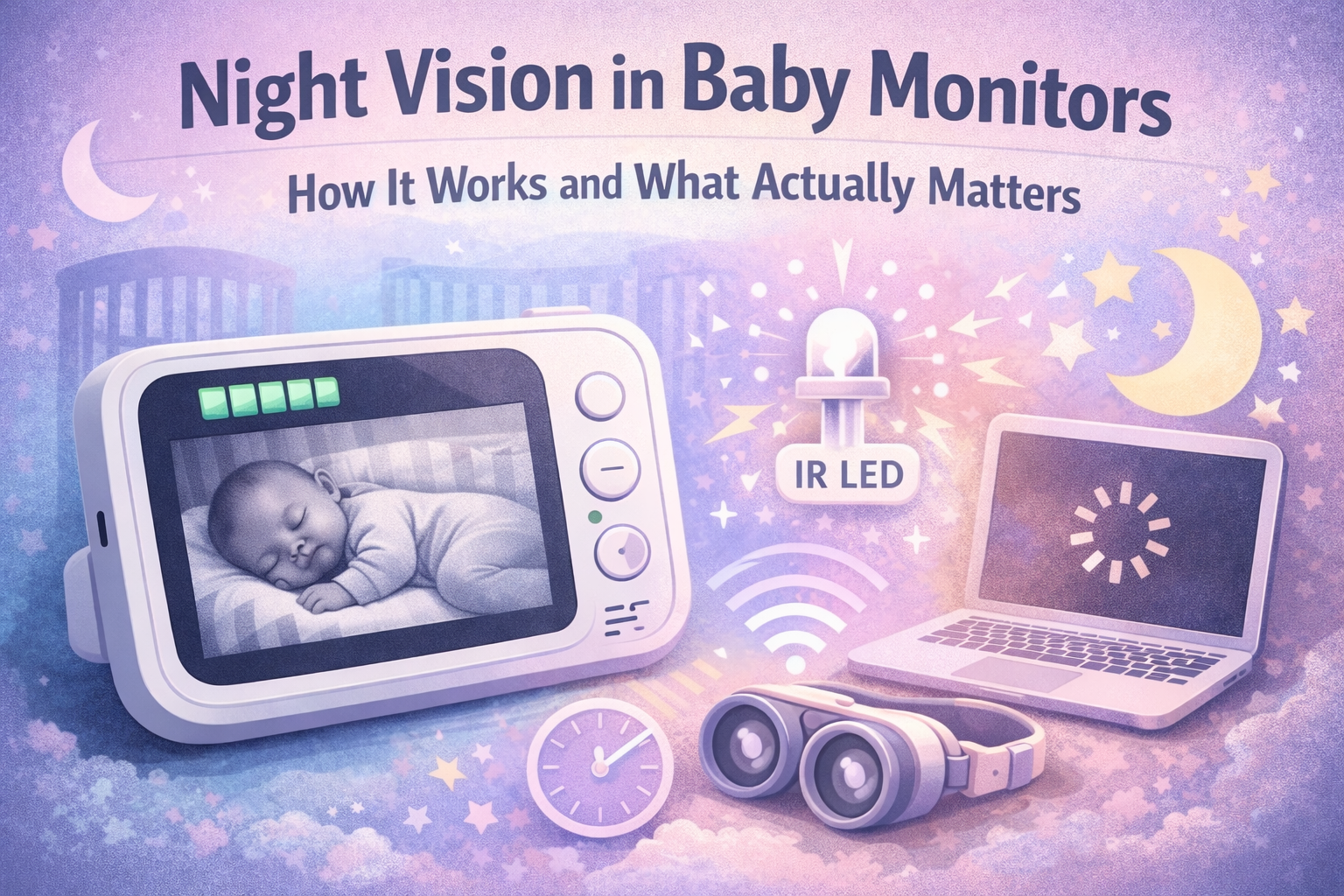
Most baby monitors use infrared (IR) night vision.
In simple terms:
- The camera emits invisible infrared light
- That light reflects off objects in the room
- The camera sensor uses that reflection to create a black-and-white image
To your eyes, the room looks completely dark.
To the camera, it’s not.
That’s why:
- The image switches to black and white at night
- And you can still see your baby even with the lights off
Why Night Vision Quality Varies So Much
Not all night vision is created equal. Image quality depends on several things:
- The quality of the camera sensor
- The strength and number of IR LEDs
- The distance between the camera and the crib
- The size and layout of the room
- How reflective the walls and furniture are
Two monitors can both “have night vision,” but one may show a clear image while the other shows a soft, noisy blur.
Is More Resolution Always Better at Night?
Not necessarily.
During the day:
- Higher resolution usually means a sharper image
At night:
- The limiting factor is often:
- The sensor quality
- The IR illumination
- Not the resolution number on the box
A well-tuned 720p or 1080p night mode often looks better than a cheap “2K” camera with weak infrared lighting.
What You Should Actually Be Able to See at Night
Good night vision should let you:
- Clearly see your baby’s position
- See major movements (rolling, sitting, standing)
- See if the blanket or sleep sack is in a normal position
You do not need:
- Perfect facial detail
- Photo-quality sharpness
What matters is clear, readable context, not cinematic quality.
Common Night Vision Problems Parents Notice
Here are the issues that come up most often:
- The image looks grainy or noisy
- The image looks washed out or foggy
- Bright white spots appear on the screen
- The baby looks “overexposed” when close to the camera
These are usually caused by:
- The camera being too close to the crib
- IR light reflecting off nearby walls or furniture
- A low-quality sensor or weak IR LEDs
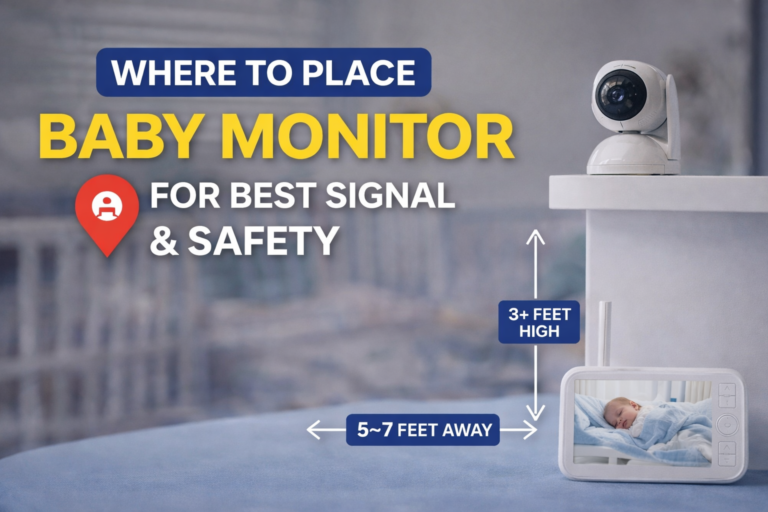
Where You Place the Camera Matters More Than You Think
Night vision is extremely sensitive to placement.
If the camera is:
- Too close to the crib, the image can look blown out
- Too far away, the image can look dark and muddy
A good rule of thumb:
Mount the camera high and angled down, not right next to the crib.
We cover this in much more detail in our placement guide, because it affects both safety and image quality.
WiFi vs Non-WiFi Monitors: Any Difference at Night?
In terms of night vision itself:
- There is no inherent advantage to WiFi or non-WiFi
The difference usually comes from:
- Camera quality
- Processing quality
- Signal stability
That said, many parents find that non-WiFi monitors feel more reliable overnight, simply because they don’t depend on apps, background processes, or internet stability.
If you’re exploring that route, you can see our full guide here:
Best Baby Monitor Without WiFi
Does Night Vision Affect Baby’s Sleep?
No.
Infrared light:
- Is invisible to the human eye
- Does not disturb sleep
- Does not light up the room
Some cameras make a faint clicking sound when switching modes, but that’s harmless and very brief.
Should You Leave a Night Light On?
Usually, no.
A night light:
- Can actually make the image worse
- Can confuse the camera’s night mode
- Often creates more glare and reflections
Modern baby monitors are designed to work in complete darkness.
How to Tell If a Monitor Has Good Night Vision (Before Buying)
Look for:
- Real user photos or videos taken at night
- Reviews that mention:
- Clarity
- Overexposure
- Graininess
- Mentions of:
- Strong IR
- Clear night image
- Stable picture in darkness
Marketing images are almost always misleading.
So, What Actually Matters With Night Vision?
In real life, the most important things are:
- A decent camera sensor
- Good infrared illumination
- Smart placement in the room
- A stable, reliable signal
Everything else is secondary.
Final Thoughts on Night Vision in Baby Monitors
Night vision is not about getting a beautiful image.
It’s about getting a reliable, readable image at 3 a.m. when you’re half asleep and just want to know if everything is okay.
If you can:
- Quickly glance at the screen
- Instantly understand what’s happening
Then the night vision is doing its job.
How does night vision in baby monitors work?
It uses infrared light to create a visible image in complete darkness.
Is night vision safe for babies?
Yes. Infrared light is invisible and does not disturb sleep.
Why does my baby monitor look grainy at night?
This is usually caused by a weak sensor, poor infrared lighting, or poor camera placement.
Should I use a night light with a baby monitor?
Usually no. Most monitors work better in complete darkness.